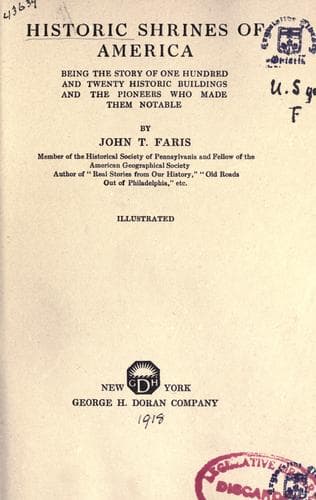
Historic Shrines of America: Being the Story of One Hundred and Twenty Historic Buildings and the Pioneers Who Made Them NotableFaris, John T. (John Thomson)
History
Historic Shrines of America: Being the Story of One Hundred and Twenty Historic Buildings and the Pioneers Who Made Them Notable
Faris, John T. (John Thomson)
Historic buildings -- United States; United States -- Biography
The spirited students were jubilant on the evening of July 9, 1776,
when the news of the Declaration of Independence was read in
Princeton. Nassau Hall was illuminated and the whole town rejoiced
that President Witherspoon, as a member of the Continental Congress,
had been a signer of the document.
In November, 1776, the students who had not enlisted in the army were
sent from the town just in time to escape the British, who took
possession of the building and used it as barracks and hospital. Early
in the morning of January 3, 1777, the British held the building.
After the battle Washington's troops took possession, but abandoned it
almost at once. At evening the British were once more in control. Soon
they hurried on to New Brunswick. The next occupants were the soldiers
of General Putnam, who found room here for a hospital, a barracks, and
a military prison. They found that during the battle of Princeton a
round shot had struck the portrait of George II in the prayer hall.
After the British left Princeton College classes were continued in the
President's house, and it was 1782 before a serious attempt was made
to reoccupy Nassau Hall, which was found to be "mostly bare partition
walls and heaps of fallen plaster."
A year later, when temporary repairs had been made, the Continental
Congress, which had been besieged by a company of troops who were
insistent in their demands for overdue pay, made its way to Princeton.
From June to November the sessions were held in Nassau Hall.
Commencement day came during the sessions and Congress sat, with
Washington, on the platform. On that occasion Washington gave fifty
pounds to the college. This sum was paid to Charles Wilson Peale for a
portrait of the donor, which was placed in the frame from which the
portrait of George II had been shot more than seven years before.
Congress was still in session at Nassau Hall when, in October, the
first authentic news came of the signing of the Definitive Treaty of
Peace with Great Britain.
A few weeks later the college was left to its sedate ways. Never
since then has it witnessed such stirring events. But the experiences
of the years from 1776 to 1784 had made Nassau Hall one of the
nation's picturesque monuments.
[Illustration: MORVEN, PRINCETON, N. J.
_Photo by R. H. Rose and Son, Princeton_
See page 134]
XXIX
THREE HISTORIC HOUSES AT PRINCETON, NEW JERSEY
MORVEN, THE MERCER HOUSE, AND WASHINGTON'S ROCKY HILL HEADQUARTERS
Public-domain text, read in full here on John Shaqi.
Reviews
Reviews
No reviews yet
Be the first to share your thoughts on this work.
Elsewhere in the archive
Join the Discussion
Join the discussion
Sign in to leave a comment or review.
Sign InorCreate an account