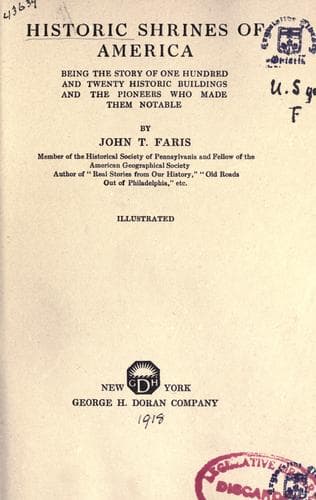
Historic Shrines of America: Being the Story of One Hundred and Twenty Historic Buildings and the Pioneers Who Made Them NotableFaris, John T. (John Thomson)
History
Historic Shrines of America: Being the Story of One Hundred and Twenty Historic Buildings and the Pioneers Who Made Them Notable
Faris, John T. (John Thomson)
Historic buildings -- United States; United States -- Biography
The real closing scene in the Revolution was Washington's farewell
address to the army, which he wrote in the southwest room of the
second story. On Sunday, November 2, from the second-story balcony, he
read this to the soldiers. Two days later orders of discharge were
issued to most of them.
Fortunately the Berrian House has become the property of "The
Washington Headquarters Association of Rocky Hill," and is open to the
patriotic pilgrim.
XXX
THE SPRINGFIELD MEETING HOUSE, NEW JERSEY
WHOSE PSALM BOOKS FURNISHED WADDING FOR THE CONTINENTAL GUNS
"One pint of spring water when demanded on the premises" was the
strange payment stipulated by the donor of one hundred acres of land
given in 1751 to the trustees of the First Presbyterian Church in
Springfield, New Jersey, to be for the use of the minister of the
parish. The church records do not state that the rent has been paid
regularly, but they do state that the woodland enabled them for many
years to furnish the free firewood that was a part of the support
promised to every one of the early pastors.
The first building occupied by the church was completed in 1746.
Fifteen years later the second building was first occupied, and it
continued to be the centre of the community's religious life until
November, 1778, when it was needed for military stores. The church was
gladly given up to the army, and services were held in the garret of
the parsonage.
The British under General Knyphausen, determined to drive Washington
and his men from the New Jersey hills and to destroy his supplies,
marched from Elizabeth Town on June 23, 1780. There were five thousand
men, with fifteen or twenty pieces of artillery, in the expedition. A
few miles away, near Springfield, was a small company of patriots,
poorly equipped but ready to die in the defence of their country.
Warning of the approach of the enemy was given to the Continentals by
the firing of the eighteen-pounder signal gun on Prospect Hill; twelve
Continentals stationed at the Cross Roads, after firing on the enemy,
had hurried to the hill. After firing the gun they lighted the tar
barrel on the signal pole.
Instantly the members of the militia dropped their scythes, seized
their muskets, and hurried to quarters. "There were no feathers in
their caps, no gilt buttons on their home-spun coats, nor flashing
bayonets on their old fowling pieces," the pastor of Springfield
church said in 1880, on the one hundredth anniversary of the skirmish
that followed, "but there was in their hearts the resolute purpose to
defend their homes and their liberty at the price of their lives."
Public-domain text, read in full here on John Shaqi.
Reviews
Reviews
No reviews yet
Be the first to share your thoughts on this work.
Elsewhere in the archive
Join the Discussion
Join the discussion
Sign in to leave a comment or review.
Sign InorCreate an account