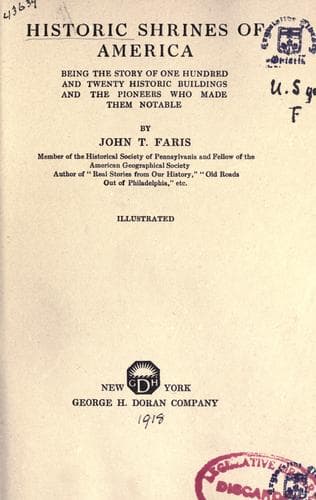
Historic Shrines of America: Being the Story of One Hundred and Twenty Historic Buildings and the Pioneers Who Made Them NotableFaris, John T. (John Thomson)
History
Historic Shrines of America: Being the Story of One Hundred and Twenty Historic Buildings and the Pioneers Who Made Them Notable
Faris, John T. (John Thomson)
Historic buildings -- United States; United States -- Biography
The sturdy farmers joined forces with the regular soldiers. For a time
the battle was fierce. The enemy were soon compelled to retreat, but
not before they had burned the village, including the church. Chaplain
James Caldwell was in the hottest of the fight. "Seeing the fire of
one of the companies slacking for want of wadding, he galloped to the
Presbyterian meeting house nearby, and rushing in, ran from pew to
pew, filling his arms with hymn books," wrote Headley, in "Chaplains
and Clergy of the Revolution." "Hastening back with them into the
battle, he scattered them about in every direction, saying as he
pitched one here and another there, 'Now put Watts into them, boys.'
With a laugh and a cheer they pulled out the leaves, and ramming home
the charge did give the British Watts with a will."
The story has been attractively told by Bret Harte:
"... Stay one moment; you've heard
Of Caldwell, the parson, who once preached the Word
Down at Springfield? What, no? Come--that's bad; why, he had
All the Jerseys aflame! And they gave him the name
Of the 'rebel high priest.' He stuck in their gorge,
For he loved the Lord God--and he hated King George!
"He had cause, you might say! When the Hessians that day
Marched up with Knyphausen, they stopped on their way
At the 'farm,' where his wife, with a child in her arms,
Sat alone in the house. How it happened none knew
But God--and that one of the hireling crew
Who fired the shot! Enough!--there she lay,
And Caldwell, the chaplain, her husband, away!
"Did he preach--did he pray? Think of him as you stand
By the old church to-day--think of him and his band
Of military ploughboys! See the smoke and the heat
Of that reckless advance, of that straggling retreat!
Keep the ghost of that wife, foully slain, in your view--
And what could you, what should you, what would you do?
"Why, just what he did! They were left in the lurch
For the want of more wadding. He ran to the church,
Broke down the door, stripped the pews, and dashed out in the road
With his arms full of hymn-books, and threw down his load
At their feet! Then above all the shouting and shots
Rang his voice, 'Put Watts into 'em! Boys, give 'em
Watts.'
"And they did. That is all. Grasses spring, flowers blow
Pretty much as they did ninety-three years ago.
You may dig anywhere and you'll turn up a ball--
But not always a hero like this--and that's all."
The battle of Springfield is not named among the important battles of
the Revolution, but it had a special meaning to the people of all that
region, for it taught them that the enemy, who had been harassing them
for months, was not invulnerable. From that day they took fresh
courage, and their courage increased when they realized that the
British would not come again to trouble them.
Public-domain text, read in full here on John Shaqi.
Reviews
Reviews
No reviews yet
Be the first to share your thoughts on this work.
Elsewhere in the archive
Join the Discussion
Join the discussion
Sign in to leave a comment or review.
Sign InorCreate an account