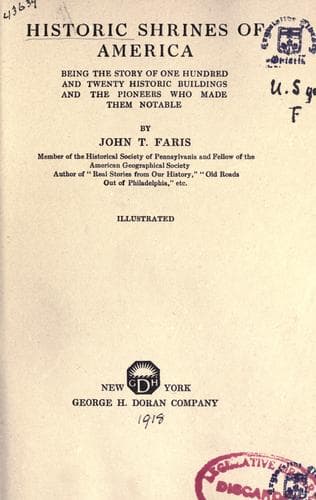
Historic Shrines of America: Being the Story of One Hundred and Twenty Historic Buildings and the Pioneers Who Made Them NotableFaris, John T. (John Thomson)
History
Historic Shrines of America: Being the Story of One Hundred and Twenty Historic Buildings and the Pioneers Who Made Them Notable
Faris, John T. (John Thomson)
Historic buildings -- United States; United States -- Biography
Penn landed at New Castle, Delaware, in October, 1682. He had already
sent forward the plot of his new country village; his cousin,
Lieutenant Governor Markham, had come to America in 1681, bringing
with him instructions for the beginning of the settlement. On this
plot there was evidence of his thought for his wife and his daughter
Letitia; two lots were set apart for the family, on one of which he
planned to build, while the other he designed for Letitia.
When he reached America, he found that, by some mistake, Letitia's lot
had been given to the Friends for a meeting house. He was vexed, but
nothing could be done. So he decided that the lot reserved for his own
use should be made over to her. He did not carry out his purpose for
some time, however.
For a time Penn remained at Upland (now Chester), but in 1684, he went
to Philadelphia to oversee the erection of the houses for the
settlers. His own house he built on a large plot facing the Delaware
River and south of what is now Market Street. The house was of brick,
which was probably made nearby, though many of the interior fittings
had been brought from England in the _John and Sarah_ in 1681. It was
the first brick house in the new settlement, the first house which had
a cellar, and was built in accordance with the request the Proprietor
had made:
"Let every house be placed, if the person pleases, in the
middle of the plat, as to breadth way of it, that so there
may be ground on each side for garden or orchard, or fields,
that it may be a green country town, which will never be
burnt and always wholesome."
For a few months the Quaker kept bachelor's hall in his new house.
Then he went to England, intending to return before long. Before his
departure he arranged that the house should be used in the public
service. Probably it was the gathering place for the Provincial
Council for many years. Thus it was the first state house of
Pennsylvania.
During the fourteen years' stay in England many misfortunes came to
Penn. He was accused of treason, and his title to the American lands
was taken away from him. Later he was acquitted, and his lands were
returned.
In 1692 Guli Penn died, and in 1696 Penn married Hannah Callowhill. In
1699, when he returned to America, he brought with him his wife and
Letitia, who was then about twenty-five years old.
Evidently the old house was not good enough for the ladies of the
family. At any rate they occupied for a time the "slate-roof house,"
one of the most pretentious buildings in the Colony. When the manor,
Pennsbury, twenty miles up the Delaware, was completed, the family was
taken there. Great style was maintained at the country estate in the
woods. The house had cost L5,000, and was "the most imposing house
between the Hudson and Potomac rivers."
Public-domain text, read in full here on John Shaqi.
Reviews
Reviews
No reviews yet
Be the first to share your thoughts on this work.
Elsewhere in the archive
Join the Discussion
Join the discussion
Sign in to leave a comment or review.
Sign InorCreate an account