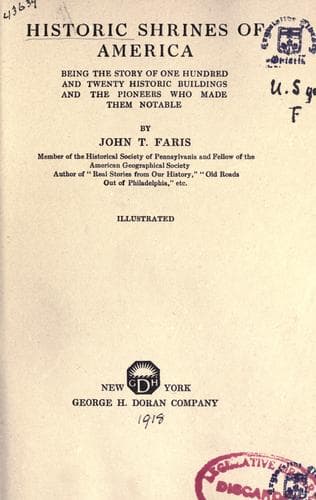
Historic Shrines of America: Being the Story of One Hundred and Twenty Historic Buildings and the Pioneers Who Made Them NotableFaris, John T. (John Thomson)
History
Historic Shrines of America: Being the Story of One Hundred and Twenty Historic Buildings and the Pioneers Who Made Them Notable
Faris, John T. (John Thomson)
Historic buildings -- United States; United States -- Biography
The Philadelphia house was transferred to Letitia on "the 29th of the
1st month 1701." At once extravagant Letitia tried to dispose of it.
She succeeded in selling a portion of the generous lot, but it was
some years before she was able to sell the whole.
In the meantime the Proprietor felt that he must return to England
because of the threat of Parliament to change the government of the
American Colonies. Mrs. Penn and Letitia, who did not like America,
pleaded to go with him. He thought he would be returning soon, and he
urged them to remain. They insisted. In a letter to James Logan he
wrote: "I cannot prevail on my wife to stay, and still less with
_Tish_. I know not what to do." Later he wrote: "The going of my wife
and Tish will add greatly to the expense.... But they will not be
denied."
In 1702 Letitia married William Aubrey, who had all of Penn's keenness
and none of his genial qualities. Almost from the day of the marriage
both husband and wife pestered Penn for money. Aubrey insisted on a
prompt payment of his wife's marriage portion. His father-in-law was
already beginning to feel the grip of financial embarrassment that
later brought him to the verge of bankruptcy, but, on this occasion as
well as later, he felt compelled to yield to the insistent demands of
the grasping Aubrey.
The only members of the Penn family who ever returned to America were
the children of the second wife, to whom most of the property
descended.
The Letitia Penn House, as it came to be known, fell on evil days. It
was an eating house in 1800, and in 1824 it was the Rising Sun Inn.
Later it was called the Woolpack Hotel.
In 1882 funds were raised by public subscription, and the venerable
house was taken down and rebuilt in Fairmount Park. Visitors who enter
the city by the Pennsylvania Railroad from New York City may easily
see it from a right-hand car window, for it is the only house in the
corner of the park on the west side of the river.
XXXII
CARPENTERS' HALL, PHILADELPHIA
CALLED BY BENSON J. LOSSING "THE TEMPLE OF FREEDOM"
Philadelphia was but forty-two years old when a number of builders in
the growing town decided to have a guild like the journeymen's guilds
of London. Accordingly they formed, in 1724, "The Carpenters' Company
of the City and County of Philadelphia," whose object should be "to
obtain instruction in the science of architecture; to assist such of
the members, or the widows and children of members, as should be by
accident in need of support," as well as "the adoption of such a
system of measurements and prices that every one concerned in a
building may have the value of his money, and every workman the worth
of his labor."
Public-domain text, read in full here on John Shaqi.
Reviews
Reviews
No reviews yet
Be the first to share your thoughts on this work.
Elsewhere in the archive
Join the Discussion
Join the discussion
Sign in to leave a comment or review.
Sign InorCreate an account