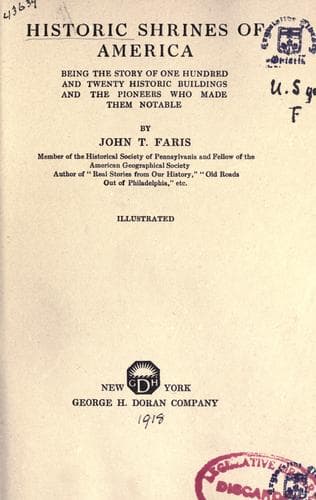
Historic Shrines of America: Being the Story of One Hundred and Twenty Historic Buildings and the Pioneers Who Made Them NotableFaris, John T. (John Thomson)
History
Historic Shrines of America: Being the Story of One Hundred and Twenty Historic Buildings and the Pioneers Who Made Them Notable
Faris, John T. (John Thomson)
Historic buildings -- United States; United States -- Biography
"Be thou present, O God of wisdom! And direct the councils of
this honorable assembly, enable them to settle things on the
best and surest foundation, that the scene of blood may be
speedily closed, that order, harmony, and peace may be
effectually restored, and truth and justice, religion and
piety, prevail and flourish amongst Thy people."
On October 26 the Congress was dissolved. The second Congress was
called to meet on May 10, 1775, at the State House, later known as
Independence Hall.
When the British took possession of the city in 1777, a portion of the
army was quartered in the building. Officers and men alike borrowed
books from the Library Company of Philadelphia, which had quarters
here, invariably making deposits and paying for the use of volumes
taken in strict accordance with the rules.
In 1778 the United States Commissary of Military Stores began to
occupy the lower story and cellar of the building. From 1791 to 1821
various public organizations sought quarters here, including the Bank
of the United States, the Bank of Pennsylvania, the United States Land
Office, and the United States Custom House. The Carpenters' Company
therefore, in 1791, erected a second building on this lot, which they
occupied until 1857.
When Benson J. Lossing visited the historic hall, on November 27,
1848, he wrote of his great disappointment because the banner of an
auctioneer was on the front of the building. He said:
"I tried hard to perceive the apparition ... to be a classic
frieze, with rich historic trigliphs, but it would not do....
What a desecration! Covering the facade of the very Temple of
Freedom with the placards of grovelling Mammon! If
sensibility is shocked with this outward pollution, it is
overwhelmed with indignant shame on entering the hall where
that august Assembly of men--the godfathers of our
Republic--convened to stand as sponsors at the baptism of
infant American liberty--to find it filled with every species
of merchandise, and the walls which once echoed the eloquent
words of Henry, Lee, and the Adamses, reverberating with the
clatter of the auctioneer's voice and hammer. Is there not
patriotism strong enough in Philadelphia to enter the temple,
and 'cast out all them that buy and sell, and overthrow the
tables of the money-changers?'"
At length the Carpenters' Company decided that the time had come to do
what the historian pleaded for. In 1857 they returned to the building,
and since then they have held their meetings within the walls
consecrated by the heroes of Revolutionary days. The rooms were
restored to their original condition, and relics and mementoes of
early days were put in place. The Hall has ever since been open to
visitors "who may wish to visit the spot where Henry, Hancock, and
Adams inspired the delegates of the Colonies with nerve and the sinew
for the toils of war."
Public-domain text, read in full here on John Shaqi.
Reviews
Reviews
No reviews yet
Be the first to share your thoughts on this work.
Elsewhere in the archive
Join the Discussion
Join the discussion
Sign in to leave a comment or review.
Sign InorCreate an account