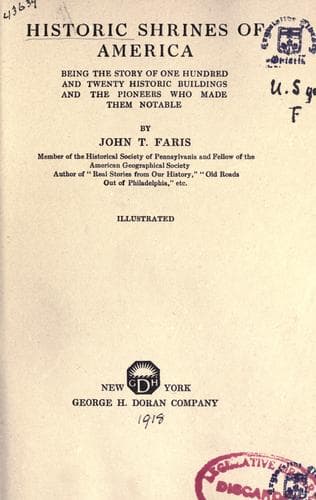
Historic Shrines of America: Being the Story of One Hundred and Twenty Historic Buildings and the Pioneers Who Made Them NotableFaris, John T. (John Thomson)
History
Historic Shrines of America: Being the Story of One Hundred and Twenty Historic Buildings and the Pioneers Who Made Them Notable
Faris, John T. (John Thomson)
Historic buildings -- United States; United States -- Biography
The wooden fence that surrounded the property originally was burned by
the British for fuel, and the brick wall that is now in place was
built in 1784.
Washington frequently occupied a pew in St. Peter's, and many other
men who were prominent in the early history of the country worshipped
here. The building is practically as it was when they lived. "It is
the same church to which the colonists in their knee-breeches and rich
coats came to attend the first service in 1761," a member of the
vestry said in 1891. "The pulpit, reading desk, and chancel rails were
built in 1764, and the present organ loft was put up over the chancel
in 1789. In all other respects the plain, austere interior of this old
church ... remains unchanged, the only relic in Pennsylvania, and one
of the very few in the country at large, of the church in colonial
days. Bishop De Lancey, in his centennial sermon, preached September
4, 1861, said: 'We enter by the same doors--we tread the same
aisles--we kneel where they knelt--we sit where they sat; the voice of
prayer, instruction, and praise ascends from the same desk from which
it reached their ears, in the privacy and seclusion of the same high,
strait unostentatious pews.'"
In the crowded churchyard are the graves of many colonial worthies as
well as many leaders in the early history of America. Stephen Decatur
is buried here, and Charles Wilson Peale, who painted a famous
portrait of Washington.
The _Pennsylvania Evening Post_ of January 18, 1777, told of the
burial of one of the patriots whose bodies were laid here:
"Yesterday the remains of Captain William Shippen, who was
killed at Princeton the third instant, gloriously fighting
for the liberty of his country, were interred in St. Peter's
Churchyard. His funeral was attended by the Council of
Safety, the members of Assembly, officers of the army, a
troop of Virginia light horse, and a great number of
inhabitants. This brave and unfortunate man was in his
twenty-seventh year, and has left a widow and three children
to lament the death of an affectionate husband and a tender
parent, his servants a kind master, and his neighbors a
sincere and obliging friend."
Captain Shippen, before joining Washington's army, was captain of the
privateer _Hancock_, which, between July 1 and November 1, 1776, sent
to American ports ten prizes captured at sea.
[Illustration: CLIVEDEN, PHILADELPHIA
_Photo by Ph. B. Wallace_
See page 156]
XXXIV
CLIVEDEN, GERMANTOWN, PHILADELPHIA
ON THE FIELD OF THE BATTLE OF GERMANTOWN
In the days before the Revolution there were many residents of
Philadelphia who had, in addition to a sumptuous town house, a country
house, to which they could resort in the summer or at other times when
they wished relief from the cares of daily life. Germantown, the
straggling village five miles from the town of William Penn, was one
of the popular places for such establishments.
Public-domain text, read in full here on John Shaqi.
Reviews
Reviews
No reviews yet
Be the first to share your thoughts on this work.
Elsewhere in the archive
Join the Discussion
Join the discussion
Sign in to leave a comment or review.
Sign InorCreate an account