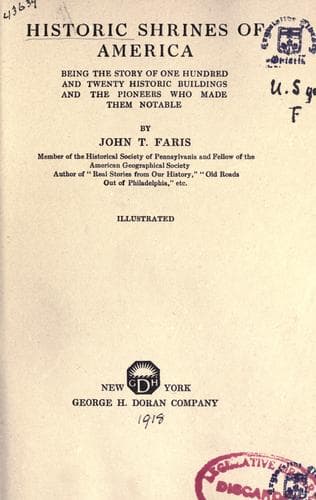
Historic Shrines of America: Being the Story of One Hundred and Twenty Historic Buildings and the Pioneers Who Made Them NotableFaris, John T. (John Thomson)
History
Historic Shrines of America: Being the Story of One Hundred and Twenty Historic Buildings and the Pioneers Who Made Them Notable
Faris, John T. (John Thomson)
Historic buildings -- United States; United States -- Biography
Samuel Chew's town house was at Front and Dock streets when he built
Cliveden at Germantown in 1761. At that time he was Attorney-General
of Pennsylvania, though in 1774 he became Chief-Justice of the Supreme
Court of Pennsylvania.
Both in Philadelphia and in Germantown he maintained the hospitable
traditions he had learned at Maidstone, near Annapolis, where he was
born, in 1722, of a family whose first American ancestor, John Chew,
came to Virginia a century earlier.
During the days of the Continental Congress Judge Chew seemed to
sympathize with the colonists in their protests against the aggression
of Great Britain, but when independence was proposed, he let it be
known that he was unwilling to act with the patriots. Accordingly he
was arrested by order of Congress, together with John Penn, and when
he refused to sign a parole, he was banished from the State.
During his absence the battle of Germantown was fought. On October 3,
1777, the British forces were disposed on nearly all sides of the Chew
mansion. Washington planned to attack these scattered forces by four
columns, which were to advance from as many directions. General
Wayne's column successfully opened the attack at daybreak October 4,
driving before him the enemy encountered at Mount Airy. Colonel
Musgrave checked the retreat of the soldiers at Cliveden. With six
companies he took possession of the mansion, prepared to defend
themselves behind hastily barricaded doors and windows. Wayne and the
leaders who were with him pushed on past the house, continuing the
pursuit of that portion of the enemy which had continued its retreat;
he did not know that he was leaving an enemy in his rear. When
Washington came to Cliveden, he was surprised by the fire of the
entrenched enemy. After a hasty conference with others, it was decided
not to pass on, leaving a fortress behind. Cannon were planted so as
to command the door, but they were fired without much effect.
The next attempt was made by a young Frenchman who asked others to
carry hay from the barn and set fire to the front door. Thinking they
were doing as he asked, he forced open a window and climbed on the
sill. From this position he was driven back, and he found that he had
not been supported by those on whom he had counted.
In the meantime the artillery fire continued, but with little effect.
General Wilkinson, who was present, afterward wrote:
Public-domain text, read in full here on John Shaqi.
Reviews
Reviews
No reviews yet
Be the first to share your thoughts on this work.
Elsewhere in the archive
Join the Discussion
Join the discussion
Sign in to leave a comment or review.
Sign InorCreate an account