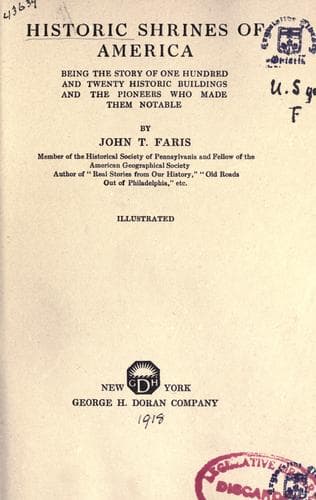
Historic Shrines of America: Being the Story of One Hundred and Twenty Historic Buildings and the Pioneers Who Made Them NotableFaris, John T. (John Thomson)
History
Historic Shrines of America: Being the Story of One Hundred and Twenty Historic Buildings and the Pioneers Who Made Them Notable
Faris, John T. (John Thomson)
Historic buildings -- United States; United States -- Biography
"The doors and shutters of the lower windows of the mansion
were shut and fastened, the fire of the enemy being delivered
from the iron gratings of the cellars and the windows above,
and it was closely beset on all sides with small-arms and
artillery, as is manifest from the multiplicity of traces
still visible from musket-ball and grape-shot on the interior
walls and ceilings which appear to have entered through the
doors and windows in every direction; marks of cannon-ball
are also visible, in several places on the exterior of the
wall and through the roof, though one ball only appears to
have penetrated below the roof, and that by a window in the
passage of the second story. The artillery seem to have made
no impression on the walls of the house, a few slight
indentures only being observable, except from one stroke in
the rear, which started the wall."
In a few minutes Washington, realizing that precious time was being
lost in the attack on the thick walls of the house, ordered a regiment
to remain behind to watch Cliveden, while his main force hastened on.
It has been claimed that this brief delay was responsible for the
defeat at Germantown. Wilkinson, on the contrary, insists that this
delay saved Washington's army from annihilation, since he would
otherwise have hurried on in the thick fog until he was in contact
with the main body of the British army. The result, he thinks, would
have been a far greater disaster than actually overtook the American
arms that day.
The damage done to the house was so great that five carpenters were
busy for months making repairs. Evidently Judge Chew was not satisfied
with the result, for in 1779 he sold Cliveden for $9,000, only to buy
it back again in 1787 for $25,000.
The property descended to Benjamin Chew, Jr., on the death of his
father. During his occupancy of Cliveden, Lafayette was a guest there
in 1825.
[Illustration: THIRD (OLD PINE STREET) PRESBYTERIAN CHURCH,
PHILADELPHIA
_Photo by Ph. B. Wallace_
See page 159]
XXXV
OLD PINE STREET CHURCH, PHILADELPHIA
WHOSE PASTOR INSPIRED JOHN ADAMS TO PLEAD FOR INDEPENDENCE
There were four thousand, seven hundred and seventy-four houses in
Philadelphia in 1767 when the Pine Street Presbyterian Church, the
third church of this denomination in the city, was built. The
subscription paper, still in existence, shows that L1,078 "in money or
otherwise" was subscribed for the purpose. The sum needed to complete
the building was raised by a lottery, which yielded L2,500. In the
proceeds of the lottery the Market Street Church and the Second Church
shared, L1,035 going to the Pine Street building.
Public-domain text, read in full here on John Shaqi.
Reviews
Reviews
No reviews yet
Be the first to share your thoughts on this work.
Elsewhere in the archive
Join the Discussion
Join the discussion
Sign in to leave a comment or review.
Sign InorCreate an account