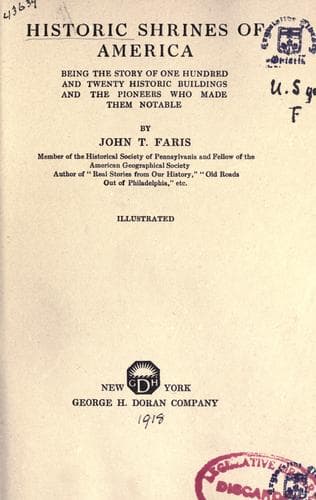
Historic Shrines of America: Being the Story of One Hundred and Twenty Historic Buildings and the Pioneers Who Made Them NotableFaris, John T. (John Thomson)
History
Historic Shrines of America: Being the Story of One Hundred and Twenty Historic Buildings and the Pioneers Who Made Them Notable
Faris, John T. (John Thomson)
Historic buildings -- United States; United States -- Biography
"When the enemy occupied Staten Island, and the American
forces were across the river on the Jersey shore, he repaired
to camp to spend the Sabbath. Assembling a portion of the
troops in an orchard, he climbed into the forks of a tree and
commenced religious exercises. He gave out a hymn.... The
British on the island heard the sound of the singing, and
immediately directed some cannon to play on the orchard, from
whence it proceeded. Soon the heavy shot came crashing
through the branches, and went singing overhead, arresting
for a moment the voices that were lifted in worship. Mr.
Duffield ... proposed that they should adjourn behind an
adjacent hillock. They did so, and continued their worship,
while the iron storm hurled harmlessly overhead."
In spite of his almost constant service in the field, Dr. Duffield was
in Philadelphia among his people every little while. The church
records show that he baptized children every month during the
Revolution, except for the period of the British occupation of
Philadelphia, when the church was occupied as a hospital, and more
than one hundred Hessian soldiers were buried in the churchyard.
Another remarkable fact is that of the one hundred and ten men who had
signed the call to George Duffield in 1771, sixty-seven served in the
army during the war. Colonel Thomas Robinson, whose portrait is in
Independence Hall, was a member of the church; Captain John Steele,
who was field officer on the day of the surrender of Cornwallis, and
Colonel William Linnard, whose company attempted to keep the British
from crossing the Brandywine, were also members. Many other officers
and private soldiers were on the rolls; the stones and vaults in the
cemetery tell of many of them.
One of the original trustees of Pine Street was Dr. William Shippen,
Jr., first Professor of Medicine in America and Director General of
all the hospitals during the war. Benjamin Rush, Signer of the
Declaration, was an attendant at the services, and his mother was a
member.
XXXVI
INDEPENDENCE HALL, PHILADELPHIA
WHERE AMERICAN INDEPENDENCE WAS BORN
William Penn was a man of vision. When, in 1682, Thomas Holme surveyed
for him the site of Philadelphia, the Quaker pioneer gave instruction
that "the Centre Square," one mile from the Delaware, be set apart
for the public buildings of the city and colony.
But for many years after the founding of the city, Centre Square was
far out in the country. During these years temporary public buildings
were provided for official meetings, including the Assembly, but in
1728 steps were taken to erect a suitable public building within reach
of the people of the young city. Ground was bought on Chestnut Street,
between Fifth and Sixth streets, and the State House was begun in
1730. The total cost of the building was $16,250. Two wings were added
in 1739 and 1740; these cost some $12,000 more.
Public-domain text, read in full here on John Shaqi.
Reviews
Reviews
No reviews yet
Be the first to share your thoughts on this work.
Elsewhere in the archive
Join the Discussion
Join the discussion
Sign in to leave a comment or review.
Sign InorCreate an account