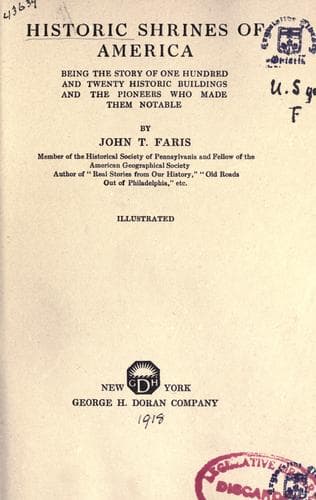
Historic Shrines of America: Being the Story of One Hundred and Twenty Historic Buildings and the Pioneers Who Made Them NotableFaris, John T. (John Thomson)
History
Historic Shrines of America: Being the Story of One Hundred and Twenty Historic Buildings and the Pioneers Who Made Them Notable
Faris, John T. (John Thomson)
Historic buildings -- United States; United States -- Biography
Two years after the completion of the main building the Pennsylvania
Assembly passed an act in which this statement was made:
"It is the true intent and meaning of these Presents, that no
part of the said ground lying to the southward of the State
House, as it is now built, be converted into or made use of
for erecting any sort of Building thereupon, but that the
said ground shall be enclosed and remain a public open Green
and Walks forever."
Eighty years after the passage of the act an attempt was made to
divert the State House yard to other purposes. In a curious old
document, dated February 6, 1816, W. Rawle and Peter S. Duponceau made
an argument against this diversion, showing conclusively that the
State House Square had been "irrevocably devoted to the purpose of an
open and public walk." Thanks to their efforts and the efforts of
others who have labored to the same end, the grounds are to-day, and
must forever remain, open to the use of the people.
The first public function held in the new State House was a banquet,
given in the "long room," in the second story. Of this Franklin's
_Pennsylvania Gazette_ of September 30, 1736, said:
"Thursday last William Allen, Esq., Mayor of this city for
the past year, made a feast for his citizens at the State
House, to which all the strangers in town of note were also
invited. Those who are judges of such things say that
considering the delicacy of the viands, the variety and
excellency of the wines, the great number of guests, and yet
the easiness and order with which the whole was conducted, it
was the most grand, the most elegant entertainment that has
been made in these parts of America."
The builders were dilatory. It was 1736 before the Assembly was able
to hold its first session in the chamber provided for it, and not
until 1745 was the room completed. Three years more passed before the
apartment intended for the Governor's Council was ready for its
occupants.
In 1741 the tower was built, and on November 4 Edmund Wooley sent to
the Province of Pennsylvania an interesting bill, "for expenses in
raising the Tower of the State House":
Public-domain text, read in full here on John Shaqi.
Reviews
Reviews
No reviews yet
Be the first to share your thoughts on this work.
Elsewhere in the archive
Join the Discussion
Join the discussion
Sign in to leave a comment or review.
Sign InorCreate an account