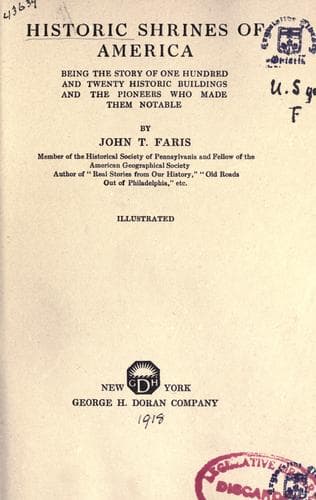
Historic Shrines of America: Being the Story of One Hundred and Twenty Historic Buildings and the Pioneers Who Made Them NotableFaris, John T. (John Thomson)
History
Historic Shrines of America: Being the Story of One Hundred and Twenty Historic Buildings and the Pioneers Who Made Them Notable
Faris, John T. (John Thomson)
Historic buildings -- United States; United States -- Biography
But when the bell was in place it was found to contain too much
copper, and Pass & Stow, the founders, "were so teazed with the
witticisms of the town," that they begged to be allowed to recast it.
In June, 1753, this third bell was hung, and in the following
September the founders were paid L60 13s. 5d.
In 1752 arrangements were made for a clock. The works were placed in
the middle of the main building, immediately under the roof. These
were connected by rods, enclosed in pipes, with the hands on the dial
plates at either gable. Early views of the State House show these
dials. The cost of the clock, which included care for six years, was
L494 5s. 5-1/2 d.
During the twenty years that followed the installation of the clock
and the bell the State House became a civic centre of note; but not
until the stirring events that led up to the Revolution did it become
of special interest to other colonies than Pennsylvania. On April 25,
1775, the day after news came to Philadelphia of the battles of
Lexington and Concord, the great bell sounded a call to arms that was
the real beginning of making the building a national shrine. In
response to the call eight thousand people gathered in the Yard to
consider measures of defence. On April 26 the newspapers reported that
"the company unanimously agreed to associate for the purpose of
defending with arms their lives, liberty, and property, against all
attempts to deprive them of them." This determination of the people
was soon sanctioned by the Assembly, and Pennsylvania prepared to
raise its quota towards the Army of the Revolution.
On May 10, 1775, the Second Continental Congress met in the Assembly
Chamber, and took action that made inevitable the adoption of the
Declaration of Independence the next year. On Friday, June 7, 1776, in
the Eastern Room on the first floor of the State House, Richard Henry
Lee of Virginia introduced the following:
"Resolved, That these United Colonies are, and of right ought
to be, free and independent States, that they are absolved
from all allegiance to the British Crown and that all
political connection between them and the State of Great
Britain is, and ought to be, totally dissolved."
At the same time the Pennsylvania Assembly was considering, in the
chamber upstairs, what instruction to give to its delegates. When the
Assembly adjourned the Continental Congress removed to the upper room.
There, on July 2, the Virginian's motion was carried. Later the
Declaration itself was adopted, and on July 4, it was
"Resolved, that Copies of the Declaration be sent to the
several assemblies, conventions, and committees or councils
of safety, and to the several commanding officers of the
Continental troops; that it be proclaimed in each of the
United States and at the head of the army."
Public-domain text, read in full here on John Shaqi.
Reviews
Reviews
No reviews yet
Be the first to share your thoughts on this work.
Elsewhere in the archive
Join the Discussion
Join the discussion
Sign in to leave a comment or review.
Sign InorCreate an account