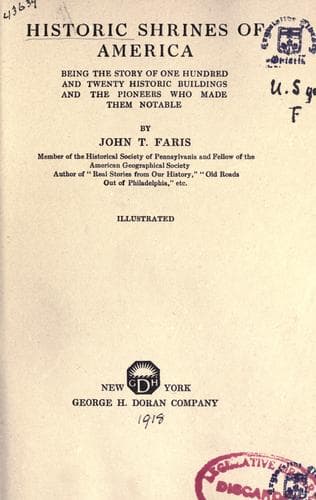
Historic Shrines of America: Being the Story of One Hundred and Twenty Historic Buildings and the Pioneers Who Made Them NotableFaris, John T. (John Thomson)
History
Historic Shrines of America: Being the Story of One Hundred and Twenty Historic Buildings and the Pioneers Who Made Them Notable
Faris, John T. (John Thomson)
Historic buildings -- United States; United States -- Biography
It was ordered that the Declaration be proclaimed from the State House
on Monday, July 8, 1776. On that day the State House bell sounded its
glad call; for the first time did it indeed "proclaim liberty
throughout all the land unto all the inhabitants thereof." And in the
hearing of those who gathered in response to its call the Declaration
was read.
From that day the State House has been known as Independence Hall,
while the State House Yard has become Independence Square.
The sittings of Congress in Independence Hall were interrupted by the
approach of the British. For five months the building was used as a
British prison and hospital. But on July 2, 1778, Congress returned;
the building once more belonged to the nation.
The building became more than ever a national shrine when, in 1787,
the Constitutional Convention met there. On September 17, 1787, the
votes of eleven States were recorded in favor of the Constitution, and
Benjamin Franklin, looking toward a sun which was blazoned on the
President's chair, said of it to those near him, "In the vicissitudes
of hope and fear I was not able to tell whether it was rising or
setting; now I know that it is the rising sun."
In 1790, the Congress of the United States met in the western portion
of the buildings on the Square, erected in 1785 for the Pennsylvania
Assembly.[1] This building was, by that body, offered to Congress and
accepted for the term of ten years, until the Capital should be
removed to the shore of the Potomac.
During these ten years, and for thirty-five years more, the Liberty
Bell continued to sound notes of joy and of sorrow. On July 8, 1835,
it was tolling for Chief Justice Marshall. When the funeral procession
was on Chestnut Street, not far from Independence Hall, the bell
cracked. Since that day it has been mute.
The passing years have brought many changes to Independence Hall, as
well as to the Liberty Bell. The bell cannot be renewed, but the
historic building and the Square have been restored until they present
essentially the appearance of the days of 1776. The chief difference
is in the steeple. The present steeple was built in 1828. It is much
like the old steeple, but a story higher.
As the visitor passes from room to room of the venerable building, and
examines the relics and studies the portraits of the great men who
gathered there so long ago, his heart is stirred to thankfulness to
those who dared to call a nation into being, and he cannot but think
that it is good to live for one's country.
[Illustration: DAVID RITTENHOUSE'S HOUSE, NORRITON, PENNA.
_Photo by Ph. B. Wallace_
See page 170]
XXXVII
THE DAVID RITTENHOUSE HOME, NEAR PHILADELPHIA
THE HEADQUARTERS OF BENJAMIN FRANKLIN'S FRIEND AND CO-LABORER
Public-domain text, read in full here on John Shaqi.
Reviews
Reviews
No reviews yet
Be the first to share your thoughts on this work.
Elsewhere in the archive
Join the Discussion
Join the discussion
Sign in to leave a comment or review.
Sign InorCreate an account