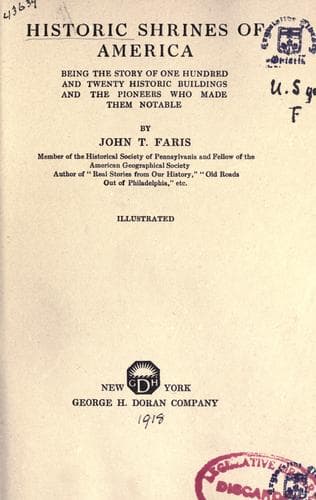
Historic Shrines of America: Being the Story of One Hundred and Twenty Historic Buildings and the Pioneers Who Made Them NotableFaris, John T. (John Thomson)
History
Historic Shrines of America: Being the Story of One Hundred and Twenty Historic Buildings and the Pioneers Who Made Them Notable
Faris, John T. (John Thomson)
Historic buildings -- United States; United States -- Biography
Washington did everything possible to provide for their comfort.
Realizing that the soldiers needed something more than the tents in
which they were living at first, he gave orders that huts should be
built for them. The commanding officers of the regiments were
instructed to divide their soldiers into parties of twelve, to see
that each party had the necessary tools, and to superintend the
building of a hut for each group of twelve soldiers, according to
carefully stated dimensions. A reward was offered to the party in each
regiment which should complete its hut in the quickest and best
manner. Since valuable time would be lost in preparing boards for the
roofs, he promised a second sword to the officer or soldier who should
devise a material for this purpose cheaper and more quickly made than
boards.
Some of the first huts were covered with leaves, but it was necessary
to provide a more lasting covering. After a few weeks fairly
acceptable quarters were provided for the men, in spite of the
scarcity of tools. Colonel Pickering, on January 5, wrote to Mrs.
Pickering, "The huts are very warm and comfortable, being very good
log huts, pointed with clay, and the roof made tight with the same."
At first, Washington sought to encourage his soldiers by assuring them
that he would accept no better quarters than could be given them; he
would set the example by passing the winter in a hut. But officers and
men alike urged that it would be unwise to risk his health in this
way, and he consented to seek quarters in a near-by house. However, he
refused to make himself comfortable until the men were provided for.
His headquarters were finally fixed in the two-story stone house of
Isaac Potts. There he met his officers, received visitors, planned for
the welfare of the army, and parried the attacks of those who could
not understand the difficulties of the situation. Once he wrote to
Congress: "Three days successively we have been destitute of bread.
Two days we have been entirely without meat. The men must be supplied,
or they cannot be commanded."
To the objections of those who thought that the army should not be
inactive during the winter weather, he wrote:
"I can assure these gentlemen, that it is a much easier and
less distressing thing to draw remonstrances in a comfortable
room by a good fireside, than to occupy a cold, bleak hill,
and sleep under frost and snow, without clothes or blankets.
However, although they seem to have little pity for the naked
and distressed soldiers, I feel superabundantly for them,
and, from my soul, I pity those miseries which it is neither
in my power to relieve or prevent."
The heavy hearts of Washington and his officers rejoiced when, on
February 23, 1778, Baron Steuben and Peter S. Du Ponceau called at
headquarters. Du Ponceau wrote later:
Public-domain text, read in full here on John Shaqi.
Reviews
Reviews
No reviews yet
Be the first to share your thoughts on this work.
Elsewhere in the archive
Join the Discussion
Join the discussion
Sign in to leave a comment or review.
Sign InorCreate an account