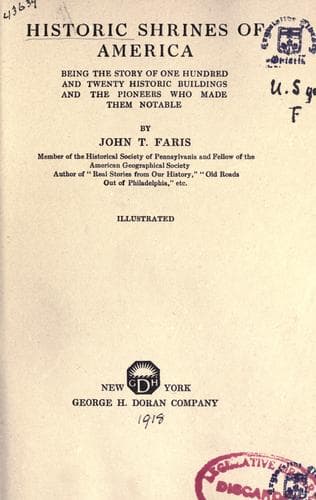
Historic Shrines of America: Being the Story of One Hundred and Twenty Historic Buildings and the Pioneers Who Made Them NotableFaris, John T. (John Thomson)
History
Historic Shrines of America: Being the Story of One Hundred and Twenty Historic Buildings and the Pioneers Who Made Them Notable
Faris, John T. (John Thomson)
Historic buildings -- United States; United States -- Biography
This was but the beginning of service to Pennsylvania during the
Revolution. His activities were so valuable to the Colonies that a
Tory poet published in the _Pennsylvania Evening Post_ of December 2,
1777, a verse addressed "To David Rittenhouse," of which the first
stanza read:
"Meddle not with state affairs,
Keep acquaintance with the stars;
Science, David, is thy line;
Warp not Nature's great design.
If thou to fame would'st rise."
The following year Thomas Jefferson wrote to him:
"You should consider that the world has but one Rittenhouse,
and never had one before.... Are those powers, then, which,
being intended for the erudition of the world, are, like
light and air, the world's common property, to be taken from
their proper pursuit to do the commonplace drudgery of
governing a single State?"
To the call of the nation Rittenhouse responded in April, 1792, when
President Washington appointed him the first Director of the Mint.
His closing years were full of honors, but his strength was declining
rapidly; he had spent himself so fully for his country that his power
of resistance was small. Just before he died, on June 26, 1796, he
said to a friend who had been writing to him, "You make the way to God
easier."
XXXVIII
THE HEADQUARTERS AT VALLEY FORGE, PENNSYLVANIA
WHERE WASHINGTON LIVED DURING THE WINTER OF 1777-78
A few rods from the beautiful Schuylkill River, at Valley Forge,
Pennsylvania, twenty-four miles from Philadelphia, is the quaint stone
house where Washington spent nearly six months of the most trying year
of the Revolution.
While the British troops were occupying Philadelphia Congress was in
session at York, Pennsylvania. Valley Forge was accordingly a
strategic location, for from here it was comparatively simple to guard
the roads leading out of Philadelphia, and to prevent both the exit of
the British and the entrance of supplies designed for the enemy.
The eleven thousand men who marched to the site selected for the camp
were miserably equipped for a winter in the open. Provisions were
scarce, and clothing and shoes were even more scarce. But the men
looked forward bravely to the months of exposure before them.
Public-domain text, read in full here on John Shaqi.
Reviews
Reviews
No reviews yet
Be the first to share your thoughts on this work.
Elsewhere in the archive
Join the Discussion
Join the discussion
Sign in to leave a comment or review.
Sign InorCreate an account