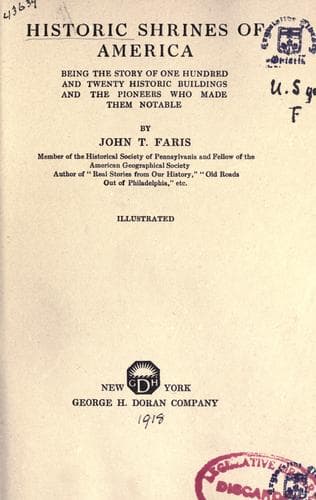
Historic Shrines of America: Being the Story of One Hundred and Twenty Historic Buildings and the Pioneers Who Made Them NotableFaris, John T. (John Thomson)
History
Historic Shrines of America: Being the Story of One Hundred and Twenty Historic Buildings and the Pioneers Who Made Them Notable
Faris, John T. (John Thomson)
Historic buildings -- United States; United States -- Biography
Mr. Breck spent his boyhood in Boston, but his parents removed to
Philadelphia in 1792 to escape what they felt was an unjust system of
taxation. During the first years of their residence in the city of
William Penn it had "a large society of elegant and fashionable and
stylish people," Mr. Breck said in his diary. "Congress held its
sessions in Philadelphia until the year 1800, and gave to the city the
style and tone of a capital. All the distinguished emigrants from
France took up their abode there."
Among the associates of the Brecks were some of the leaders of the new
nation. Samuel Breck was frequently at the Robert Morris house, and
later, during the four years' imprisonment of Mr. Morris, he "visited
that great man in the Prune Street debtors' apartment, and saw him in
his ugly whitewashed vault."
The diarist's comment was bitter: "In Rome or Greece a thousand
statesmen would have honored his mighty services. In a monarchy ... he
would have been appropriately pensioned; in America, Republican
America, not a single voice was raised in Congress or elsewhere in aid
of him or his family."
There is not a more striking passage in the diaries than that written
on August 27, 1814, during the second war with England:
"I was in town to-day ... at half past twelve o'clock I went
with an immense crowd to the post-office to hear the news
from the South. The postmaster read it to us from a chamber
window. It imported that the navy-yard had been burnt (valued
at from six to eight millions of dollars) including the new
frigate _Essex_, sloop-of-war _Argus_, some old frigates, a
vast quantity of timber, from five to eight hundred large
guns, and many manufactories of cordage, etc., by our people;
that the President's House, Capitol, and other important
buildings had been destroyed, and all this by a handful of
men, say, six thousand!"
The diary told also of some interesting experiences at the mansion on
the Schuylkill. In 1807 "a newly invented iron grate calculated for
coal" was installed at Sweetbrier. After less than three weeks' trial
Mr. Breck wrote, "By my experiment in coal fuel I find that one
fireplace will burn from three to three and a half bushels per week in
hard weather and about two and a half in moderate weather. This
averages three bushels for twenty-five weeks, the period of burning
fire in parlors." The coal cost forty-five cents a bushel, and Mr.
Breck decided that wood was a cheaper fuel.
Even in those early days city families had their troubles with
servants. "This is a crying evil, which most families feel very
sensibly at present," was Mr. Breck's sorrowful statement. Fifteen
years after this entry was written, a bitter complaint was made:
Public-domain text, read in full here on John Shaqi.
Reviews
Reviews
No reviews yet
Be the first to share your thoughts on this work.
Elsewhere in the archive
Join the Discussion
Join the discussion
Sign in to leave a comment or review.
Sign InorCreate an account