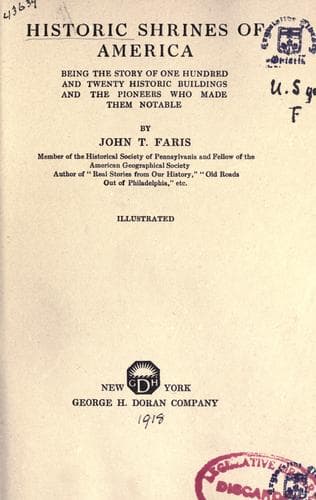
Historic Shrines of America: Being the Story of One Hundred and Twenty Historic Buildings and the Pioneers Who Made Them NotableFaris, John T. (John Thomson)
History
Historic Shrines of America: Being the Story of One Hundred and Twenty Historic Buildings and the Pioneers Who Made Them Notable
Faris, John T. (John Thomson)
Historic buildings -- United States; United States -- Biography
"In my family, consisting of nine or ten persons, the
greatest abundance is provided; commonly seventy pounds of
fresh butcher's meat, poultry and fish a week, and when I
have company nearly twice as much; the best and kindest
treatment is given to the servants; they are seldom visited
by Mrs. Breck, and then always in a spirit of courtesy; their
wages are the highest going, and uniformly paid to them when
asked for; yet during the last twelve months we have had
seven different cooks and five different waiters.... I pay,
for instance, to my cook one dollar and fifty cents, and
chambermaid one dollar and twenty-five cents per week; to my
gardener eleven dollars per month; to the waiter ten dollars;
to the farm servant ten dollars, etc., etc. Now, if they
remain steady (with meat three times a day) for three or four
years, they can lay by enough to purchase two or three
hundred acres of new land."
On one occasion, learning that the ship _John_ had arrived from
Amsterdam, Mr. Breck visited it in search of men and women. He wrote:
"I saw the remains of a very fine cargo, consisting of
healthy, good-looking men, women and children, and I
purchased one German Swiss for Mrs. Ross and two French Swiss
for myself.... I gave for the woman seventy-six dollars,
which is her passage money, with a promise of twenty dollars
at the end of three years, if she serves me faithfully,
clothing and maintenance of course. The boy had paid
twenty-six guilders towards his passage money, which I have
agreed to give him at the end of three years; in addition to
which I paid fifty-three dollars and sixty cents for his
passage, and for two years he is to have six weeks' schooling
each year."
It was like Mr. Breck to make the provision for schooling. He was an
ardent friend of education in an age when too many were indifferent.
In 1834, when the fortunes of a proposal for free schools in
Pennsylvania were in doubt, he consented to become a member of the
State Senate. There he bent every effort to secure the passage of a
generous provision for common schools. On the first day of the session
he moved successfully for the appointment of a Joint Committee on
Education of the two Houses, "for the purpose of digesting a general
system of education." Of this committee he was made chairman.
After seven weeks of unremitting labor the bill incorporating the
committee's report, a bill drafted by Mr. Breck, was introduced. In
six weeks more it became a law, four votes only having been cast
against it. Wickersham, in his "History of Education in Pennsylvania,"
says that the passage of the bill was "the most important event
connected with education in Pennsylvania--the first great victory for
free schools."
Public-domain text, read in full here on John Shaqi.
Reviews
Reviews
No reviews yet
Be the first to share your thoughts on this work.
Elsewhere in the archive
Join the Discussion
Join the discussion
Sign in to leave a comment or review.
Sign InorCreate an account