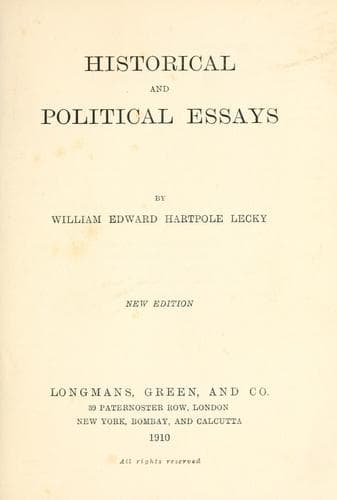
Historical and Political EssaysLecky, William Edward Hartpole
History
Historical and Political Essays
Lecky, William Edward Hartpole
History; Political science
The question was debated in both the Lords and Commons in 1808. In the
former it was lost by a majority of 87, and in the latter by a
majority of 153. Grattan on this occasion introduced the Catholic
petition in a speech of consummate power; but both Castlereagh and
Canning opposed the reception of the petition, on the ground that the
time was unsuited for the agitation of the question; and the spirit of
the ruling part of the Ministry was sufficiently shown by the
reduction of the Maynooth grant from 13,000_l._ to 9,250_l._ When the
Portland Government was broken up in September 1809 by the quarrel,
duel, and resignation of Canning and Castlereagh, Perceval became the
head of the new Ministry, Lord Wellesley occupying the place of
Canning, and Lord Hawkesbury that of Castlereagh; and an intensely
anti-Catholic ministry continued to the death of Perceval. In 1809 the
Catholic question was not introduced into Parliament. In the spring of
1810 it was introduced into both Houses, but was defeated by
majorities of 86 and 104; but in October 1810 an event occurred which
profoundly changed the aspect of affairs. The King's insanity broke
out anew in a form which gave little hope of recovery, and the Prince
of Wales was appointed Regent. For a year the regency was subject to
restrictions similar to those which had been adopted in 1788, but on
February 1, 1812, these restrictions were to cease, and the Regent was
to enter into full fruition of the royal power.
The hopes of the Catholics were now raised to the highest point. With
the confirmed insanity of George III. the most serious of all the
obstacles to their claims was removed. During the year of the
restricted regency, while there was still some chance of the recovery
of the King, the Prince of Wales declined to remove the existing
Ministry from office, though even this decision was not taken without
some hesitation and some negotiations with the Whigs. The Catholics,
however, fully expected that the royal influence would now be exerted
in their favour, and that the Whig Ministry would speedily come. The
Prince of Wales had long been in close connection with the Whigs. As
early as 1797 he had expressed a desire to go over to Ireland as
Lord-Lieutenant, carrying with him a policy of conciliation to the
Catholics. In 1805, when Fox and Grenville had introduced the Catholic
question into the Imperial Parliament, the Prince, while stating that
considerations of obvious delicacy prevented him from taking an
immediate and open part in its favour, had given the Whig leaders the
fullest authority to assure the Catholics of Ireland that he would
never forsake their interests, the 'most distinct and authentic
pledge' of his wish to relieve them from the disabilities of which
they complained, and to exert himself in their favour as soon as he
was constitutionally able to do so. It is easy therefore to imagine
the consternation and the indignation with which, in 1812, the
Public-domain text, read in full here on John Shaqi.
Reviews
Reviews
No reviews yet
Be the first to share your thoughts on this work.
Elsewhere in the archive
Join the Discussion
Join the discussion
Sign in to leave a comment or review.
Sign InorCreate an account