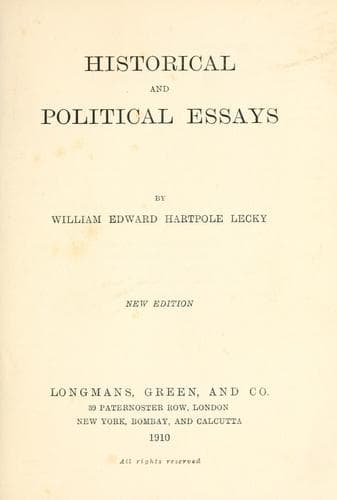
Historical and Political EssaysLecky, William Edward Hartpole
History
Historical and Political Essays
Lecky, William Edward Hartpole
History; Political science
Catholics found that the Prince Regent had changed his principles and
his policy; that, after a short and perhaps insincere negotiation with
the Whigs, he had resolved to maintain in power a Ministry which was
constructed for the main purpose of maintaining the Catholic
disabilities; and that his own opinions were rapidly verging towards
this policy.
The situation in Ireland was becoming very dangerous. For some years
after the Union a great apathy prevailed, and there is no reasonable
doubt that, if events in England had been favourable, Catholic
emancipation would have met with no serious opposition in Ireland, and
could have been carried with every reasonable limitation and
safeguard. The most competent English officials calculated that at
least sixty-four of the hundred Irish representatives would vote for
it, and that a decided preponderance of Irish Protestant opinion was
in its favour. On the other hand, the Catholic bishops and aristocracy
had fully accepted the policy of an endowment for the priests and a
veto on the appointment of bishops, and the most Conservative elements
in the Catholic body still exercised an ascendancy over their
co-religionists. The question of the veto had been mentioned in the
Commons, by Sir J. Hippisley, in 1805, and in 1808 Grattan and
Ponsonby formally announced, on the authority of the Catholic bishops,
their readiness to accept it. A letter from Bishop Milner was read to
the House, which very clearly stated their position:
'The Catholic prelates of Ireland,' he wrote, 'are willing to give a
direct negative power to his Majesty's Government with respect to the
nomination of their titular bishoprics, in such manner that when they
have among themselves resolved who is the fittest person for the
vacant see, they will transmit his name to his Majesty's Ministers;
and if the latter should object to that name, they will transmit
another and another, until a name is presented to which no objection
is made; and (which is never likely to be the case) should the Pope
refuse to give those essentially necessary spiritual powers, of which
he is the depository, to the person so presented by the Catholic
bishops and so approved by the Government, they will continue to
propose names till one occurs which is agreeable to both
parties--namely, the Crown and Apostolic See.'
Public-domain text, read in full here on John Shaqi.
Reviews
Reviews
No reviews yet
Be the first to share your thoughts on this work.
Elsewhere in the archive
Join the Discussion
Join the discussion
Sign in to leave a comment or review.
Sign InorCreate an account