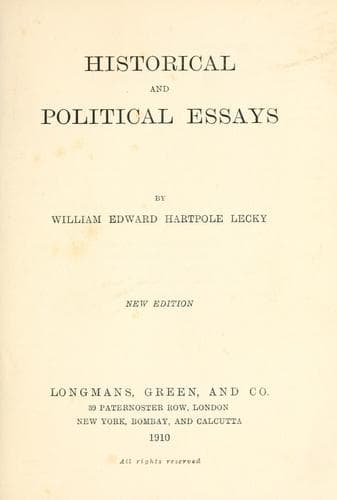
Historical and Political EssaysLecky, William Edward Hartpole
History
Historical and Political Essays
Lecky, William Edward Hartpole
History; Political science
In the new Parliament the Catholic question at once assumed a great
prominence. A motion for the immediate consideration of the laws
affecting the Catholics was introduced by Grattan, supported by
Castlereagh, opposed by Peel, and ultimately carried by a majority of
40. A resolution of Grattan's for removing laws imposing civil and
military disabilities on the Catholics, with such regulations and
exceptions as might provide for the security of the Protestant
succession and of the Established Church, was next introduced. Peel
opposed it bitterly, but was beaten by a majority of 67.
'We were terribly beaten,' he wrote to his Under-Secretary, 'but we
are sad cowards, I am afraid; at least, we are shamefully used. Poor
Duigenan could not get a hearing, and the general impression seemed
against the Protestants. We will fight them out, however, to the last.
I am sure it is better than to give way.' 'Your defence of the
Protestant cause,' wrote Saurin, 'was not only by far the ablest and
best, but the only one which did not seem to strengthen the cause of
the adversary by some concession of principle. I really fear the
Protestant cause is lost in the Commons. There can be no rally now but
on the securities.'[16]
Grattan at once brought in a Bill in accordance with the terms of the
Resolution that had been carried; but the Protestant party now rallied
around a motion of Sir John Hippisley, for a committee to inquire into
the state and tenets of the Roman Catholics, and the laws affecting
them. Canning pointed out with great force that a committee of inquiry
was exactly what the Protestant party had for so many years
strenuously resisted; but, as Peel wrote to the Duke of Richmond,
there was no inconsistency in their conduct: 'When the question was
whether we should consider the claims of the Catholics and the laws
affecting them, or should resist their claims, we voted for resistance
without inquiry; the question now is, whether we shall consider or
concede, and we prefer inquiry to concession.'[17]
The motion for delay, however, was defeated by 187 to 235, and the
second reading of Grattan's Bill was carried by 245 to 203. But a
sudden change now occurred in the prospects of the cause. Canning and
Castlereagh, with the full assent of Grattan, introduced clauses for
the securities which had been before intimated, giving the Crown a
control over the nomination of the Catholic bishops. But the bishops
unanimously condemned the proposal, and the large majority of the
Catholic Board supported them. It became evident that the Bill before
Parliament would fail to satisfy the Catholics, and after a long
discussion the clause admitting Catholics to Parliament was rejected
by 251 to 247.
Public-domain text, read in full here on John Shaqi.
Reviews
Reviews
No reviews yet
Be the first to share your thoughts on this work.
Elsewhere in the archive
Join the Discussion
Join the discussion
Sign in to leave a comment or review.
Sign InorCreate an account