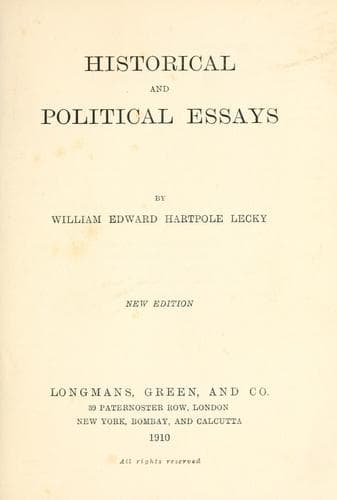
Historical and Political EssaysLecky, William Edward Hartpole
History
Historical and Political Essays
Lecky, William Edward Hartpole
History; Political science
fifteen more years of demoralising and disorganising agitation before
the Catholic question was settled.
Canning, however, as an independent member, brought forward a
resolution pledging the House to an early consideration of the laws
affecting his Majesty's Roman Catholic subjects, with a view to their
final conciliatory adjustment, and the conditions of the question had
so profoundly changed that it was carried by a majority of 129; while
a similar motion by Lord Wellesley in the House of Lords was met by
the previous question, which was carried by a majority of only one.
Peel, though he had come into Parliament as a special follower of
Perceval, had not yet pledged himself decisively against the
Catholics. He had voted silently against Canning's motion in June, and
although he had spoken against a previous motion of Grattan, he had
done so mainly on the ground that the time was not opportune, and had
expressly guarded himself against giving any positive pledge. He was
now, however, obliged to take a more prominent part, and for the next
six years he was the chief support of the anti-Catholic party in
Parliament. His part was a very difficult one, for he had to encounter
Grattan, Plunket, Canning, and the Whig leaders, and he had scarcely
any real supporters. Saurin, the Attorney-General, it is true, was
strongly opposed to all concession. He was a lawyer of high character
and attainments, of Huguenot descent and strong Huguenot principles,
and he had borne a distinguished part in opposition to the Union; but
Saurin refused to go to London. Bushe, who was Solicitor-General,
leaned to the Catholic side; and, to the great indignation and
consternation of the Government, Wellesley Pole, who had preceded Peel
as Chief Secretary and who was the brother of Lord Wellesley, now
pronounced himself strongly in Parliament in favour of the Catholics.
This speech was entirely unexpected, for Pole had hitherto been
regarded as a staunch adherent of the Protestant party, and as late as
the last day of 1811 he had sent a memorandum on the Catholic question
to the Secretary of State in England, which was intended to be laid
before the Cabinet, and which maintained the impossibility of safely
satisfying the Catholic claims, and the expediency of the Prince
Regent's taking a decided part against them. A general election had
taken place in September, and it is evident from the letters of Lord
Liverpool and Peel that they at this time looked upon Canning and his
followers with even more hostility than the regular Opposition.
Public-domain text, read in full here on John Shaqi.
Reviews
Reviews
No reviews yet
Be the first to share your thoughts on this work.
Elsewhere in the archive
Join the Discussion
Join the discussion
Sign in to leave a comment or review.
Sign InorCreate an account