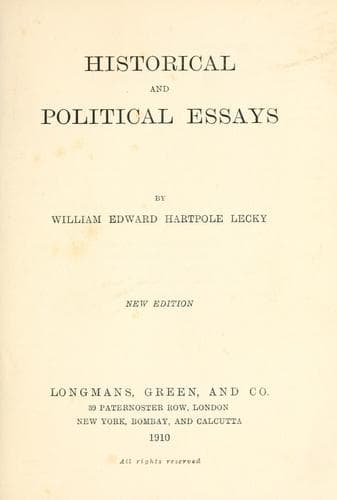
Historical and Political EssaysLecky, William Edward Hartpole
History
Historical and Political Essays
Lecky, William Edward Hartpole
History; Political science
To the tithe system he would do nothing, and this is one of the fatal
blots on his reputation as a statesman. There was no single source of
crime, agitation, and disaffection in Ireland which was so prolific as
this, and there was no subject on which the wisest statesmen had been
more agreed than on the supreme importance of meeting this evil by a
judicious system of commutation. Pitt had clearly expressed his
opinion of the necessity of such a commutation to the Duke of Rutland
as early as 1786, and it was one of the measures which he intended to
have followed the Union. Grattan had brought schemes of commutation in
three successive years before the Irish Parliament. Lord Loughborough,
who was the chief cause of the failure of Catholic emancipation after
the Union, had himself drawn up a Tithe Commutation Bill. Lord
Redesdale, who represented the extreme Toryism of the ministry of
Addington, strongly urged the absolute necessity of speedy legislation
on the subject. The Duke of Bedford, in 1807, dwelt on the importance
of commuting tithes into a land-tax, and ultimately into land. Parnell
and Grattan had brought the subject before the Imperial Parliament in
1810, and it was again and again insisted on by the Whig writers, and
nowhere more strongly than in Sydney Smith's admirable letters to
Peter Plymley and in some of the pages of the 'Edinburgh Review.' But
nothing was done till the evil had become intolerable, and had brought
the country to a state of anarchy and demoralisation that can scarcely
be exaggerated. The connection of Peel with the question of Irish
tithes is a very remarkable one. The Tithe Commutation Act, which was
carried by a Whig Government in 1838, is one of the few instances of
perfectly successful legislation in Irish history, and it is well
known that the chief credit of this measure does not belong to the
Ministers who carried it. It was the very measure which Sir Robert
Peel had introduced in 1835, which the Whig party when in opposition
defeated by connecting it with the Appropriation clause, and which the
Whig party when in power were compelled to carry without that clause.
But if the chief credit of the final settlement of this momentous
question justly belongs to Peel, it must not be forgotten that in the
eleven years during which, as Chief Secretary or as Home Secretary, he
was directly responsible for the government of Ireland, he had allowed
this monster curse to grow and strengthen without making any serious
effort to mitigate it.
Public-domain text, read in full here on John Shaqi.
Reviews
Reviews
No reviews yet
Be the first to share your thoughts on this work.
Elsewhere in the archive
Join the Discussion
Join the discussion
Sign in to leave a comment or review.
Sign InorCreate an account