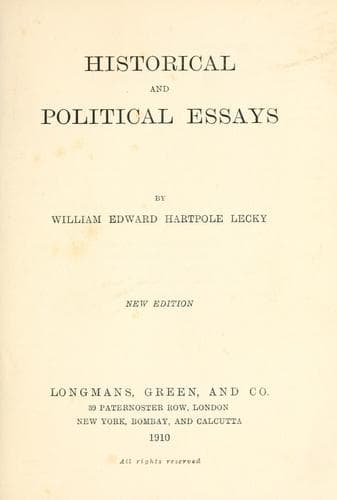
Historical and Political EssaysLecky, William Edward Hartpole
History
Historical and Political Essays
Lecky, William Edward Hartpole
History; Political science
Peel was Chief Secretary during the concluding part of the viceroyalty
of the Duke of Richmond, during the whole of that of Lord Whitworth,
and during part of that of Lord Talbot. He had grown very tired of his
position, but agreed to postpone his departure till after a general
election, and he at last left Ireland, as he says, with 'undiminished
and unqualified satisfaction,' in August 1818. He remained out of
office until January 1822; but the interval was not spent in idleness,
and in 1819 he took the leading part in the great Act for resuming
cash payments, which, as it has been truly said, attaches to his name
'the same meed of praise which he had quoted as inscribed on the tomb
of Queen Elizabeth: "Moneta in justum valorem redacta."' It is one of
his greatest legislative achievements; it is also the first of that
series of recantations which forms one of the most distinctive
features of his career, for it was based upon the policy which Horner
had advocated in 1811, and against which Peel had then voted. He still
took, on the Catholic question, the leading part in opposition to
emancipation, declaring his determination to offer 'a most sincere and
uncompromising,' though he now feared unavailing, resistance to
Catholic concession. The last time the question was brought forward,
by Grattan, was in 1819, and he was defeated by a majority of only
two. In 1821, after the death of Grattan, and in a new Parliament,
Plunket carried a Bill for Catholic emancipation successfully through
all its stages in the House of Commons, though it was afterwards
rejected in the Lords. In the ensuing session a similar fate befel a
Bill of Canning's to relieve Catholic peers of their disabilities.
Some considerable change, however, was introduced into the spirit of
the Irish Government by the appointment of Lord Wellesley, who was in
favour of the Catholics, to the viceroyalty. One of its most important
results was the removal of Saurin from the office of Attorney-General
and the appointment of Plunket in his place. Lord Wellesley described
this measure to Lady Blessington as the removal of 'an old Orangeman'
who, though 'Attorney-General by title, had really been
Lord-Lieutenant for fifteen years'; but it is evident from the letters
of Peel that his warm sympathies, both personal and political, were
with Saurin.
Public-domain text, read in full here on John Shaqi.
Reviews
Reviews
No reviews yet
Be the first to share your thoughts on this work.
Elsewhere in the archive
Join the Discussion
Join the discussion
Sign in to leave a comment or review.
Sign InorCreate an account