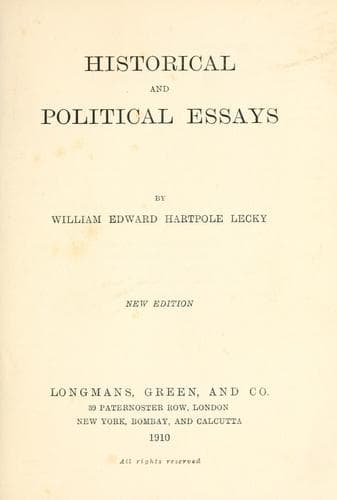
Historical and Political EssaysLecky, William Edward Hartpole
History
Historical and Political Essays
Lecky, William Edward Hartpole
History; Political science
On matters unconnected with the Catholic question his administration
was skilful and, on the whole, enlightened; and in 1823 he introduced
the first of a series of important measures diminishing the enormous
number of capital offences that disgraced the English criminal code,
and, at the same time, doing much to simplify and consolidate that
code. In this, as in most respects, there was little original in his
legislation. He followed, at some distance, in the steps of Romilly
and Mackintosh, and he left very much to be done, which was chiefly
accomplished during the Whig ascendancy that followed the Reform Bill
of 1832. It appears, from some remarkable letters in this volume,
that, before Peel took up the question of criminal reform, George IV.
was exceedingly sensible of the enormity of executing very young men
for secondary offences, and that he was continually pressing on his
Ministers a more merciful administration of the law. He sometimes
found Peel by no means ready to yield. In one case Peel invoked the
aid of the Cabinet to overrule the wish of the King, who desired to
save two culprits from the gallows; and, in another case, he
threatened to resign his office if the King persisted in commuting the
sentence of a youth who had been found guilty of uttering forged
notes.[37] But Peel had at least the merit of recognising an
intolerable abuse, and his legislation on the subject was skilfully
framed and still more skilfully introduced and carried. In his
patronage in this, as in later periods of his life, he cared much more
than most English Ministers for the interests of science, literature,
and art. He was by no means indifferent to the opportunities his
position gave him of advancing his own family and friends; but he
never, in his English patronage, forgot the character of those whom he
recommended for promotion, and he brought forward or assisted many men
of ability and learning with whom he had no connection and no
political sympathy. The letters in this volume between Peel and his
very intimate Oxford friend Dr. Lloyd are especially interesting and
characteristic. They are in general very honourable to Peel; but Mr.
Parker is much too indulgent when he describes the intensely worldly
letters in which Dr. Lloyd urged his own merits and his claims to the
bishopric of Oxford as merely 'frank, and free from affectation of the
traditional _nolo episcopari_.' Both Peel and Lord Liverpool appear to
have had a much stronger sense than most of their predecessors of the
responsibilities attaching to Church patronage and of the duty of
administering it in the public interest, and in this respect they were
broadly distinguished from Lord Eldon.
Public-domain text, read in full here on John Shaqi.
Reviews
Reviews
No reviews yet
Be the first to share your thoughts on this work.
Elsewhere in the archive
Join the Discussion
Join the discussion
Sign in to leave a comment or review.
Sign InorCreate an account