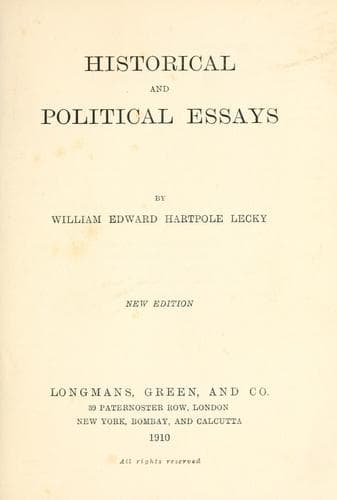
Historical and Political EssaysLecky, William Edward Hartpole
History
Historical and Political Essays
Lecky, William Edward Hartpole
History; Political science
'It is really a cruel thing,' Lord Liverpool wrote to Peel, 'that the
patronage of the Crown as to Church matters should be divided between
the Minister and the Chancellor, and that all the public claims should
fall upon the former. The Chancellor has nine livings to the
Minister's one. With respect to these he does occasionally attend to
local claims, but he has besides four cathedrals, and to no one of
these cathedrals has any man of distinguished learning or merit been
promoted.'
In the beginning of 1825 the Irish Government, having without
consulting Peel undertaken a foolish prosecution of O'Connell for a
not very dangerous speech, received a heavy rebuff, for the Grand
Jury threw out the Bill, and the prosecution of an Orange leader was
equally unsuccessful. A Bill was about the same time brought in and
carried, suppressing the new association; but it could not suppress
the spirit which it had aroused. O'Connell, however, was thoroughly
alarmed at the state of the country, and as far as possible from
desiring a rebellion, and he was at this time in a very conciliatory
mood. He was perfectly ready to accept an endowment for the
priesthood, which would attach them to the Government, and also a
considerable raising of the Irish franchise. This was the last
occasion on which his party and the Catholic gentry very cordially
concurred, and it was the last occasion on which the Catholic question
could have been settled on a basis that would have given real strength
to the Empire. A Relief Bill passed through all its stages in the
Commons by considerable majorities, and it was followed by a Bill for
raising the qualifications of Irish electors, and by a resolution for
endowing the priesthood. O'Connell fully believed that Catholic
emancipation would definitely pass in this session,[38] and he
appeared to have excellent reasons for his belief. In Ireland it
generally prevailed, and it exercised an immediate pacifying
influence. Lord Fingall and other Catholic noblemen, in presenting an
address at this time to the King, were able to say 'the whole of
Ireland reposes in profound tranquillity, and the law, without the aid
of any extraordinary power, everywhere receives voluntary obedience.'
It was afterwards stated by Lord George Bentinck that Peel had changed
his opinions about Catholic emancipation in 1825, and had communicated
this change to Lord Liverpool. The letters before us, however,
conclusively prove that if Peel was shaken, it was not about the
merits of emancipation, but about the practicability of resisting it.
Having been four times defeated in the Commons on the Catholic
question, he tendered his resignation, and Lord Liverpool at once
declared that without his assistance he could not continue the
struggle. Peel was the only Minister in the House of Commons opposed
to the Catholic cause, differing on the question from all his
colleagues in the House. If he had resigned, and if Lord Liverpool had
Public-domain text, read in full here on John Shaqi.
Reviews
Reviews
No reviews yet
Be the first to share your thoughts on this work.
Elsewhere in the archive
Join the Discussion
Join the discussion
Sign in to leave a comment or review.
Sign InorCreate an account