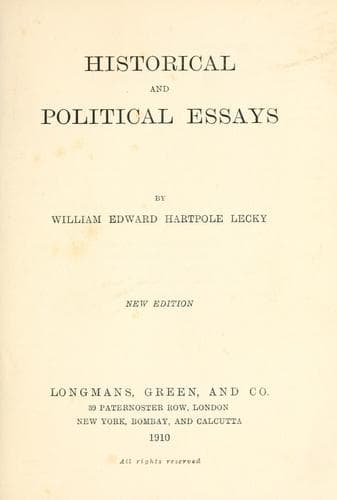
Historical and Political EssaysLecky, William Edward Hartpole
History
Historical and Political Essays
Lecky, William Edward Hartpole
History; Political science
followed his example, there is good reason to believe that a
Government might have been formed which would have carried the measure
safely and speedily with the securities that had been accepted. Most
unfortunately for the Empire, the 'Protestant' party persuaded Peel to
withdraw his resignation in order to avert this surrender. In the
House of Lords the Duke of York, who was the heir-presumptive to the
throne, stood up and declared his unalterable opposition to the
Catholic claims, 'whatever might be his situation in life, so help him
God,' and the Lords rejected the Bill by a majority of 48.
The conscientious views of George III. obtained some measure of
respect even from those who believed them to be most unfounded; but no
halo of sanctity dignified the scruples of George IV. or of the Duke
of York. The Irish Catholics, exasperated at the present
disappointment of their hopes, and at the prospect of another hostile
King, flung themselves into a furious agitation, and in a few months
all the progress which had been made towards pacifying the country was
undone, while in England Peel had to meet a terrible commercial
crisis. Seventy county banks stopped in less than a week. In dealing
with questions of commerce and currency Peel was always in his
element, and his measures appear to have been wise and skilful. A
general election took place, and he was again returned by the
University of Oxford as the uncompromising opponent of Catholic
emancipation. In England the anti-Catholic party gained some seats,
and the increasing violence in Ireland had produced some reaction. In
Ireland it was soon apparent that what Grattan had feared had come to
pass, and that the tie which had hitherto attached the people to their
landlords was completely broken. The priests everywhere appeared at
the head of their people, and it was at once seen that a new and
terrible power was dominating Irish politics. In Waterford, where the
Beresfords had long been omnipotent, they were totally defeated, and
Leslie Foster sent Peel a vivid description of his own defeat in the
Louth election. At the outset of the contest, upwards of five-sixths
of the votes were promised to him; but the whole priesthood turned
themselves into electioneering agents against him. In every chapel
there were political sermons; the priests menaced all who voted for
him with eternal damnation; they were present at every polling-booth
to overawe their parishioners; and their efforts were seconded by
savage mobs who waylaid and beat all opponents, and forced multitudes
of Protestants, by threats of assassination or of the burning of their
houses, to vote against their promises and their convictions. 'In the
county town the studied violence and intimidation were such that it
was only by locking up my voters in enclosed yards that their lives
were preserved.' By these means the election was won. What, asked
Foster, will be the end of this? 'The landlords are exasperated to the
Public-domain text, read in full here on John Shaqi.
Reviews
Reviews
No reviews yet
Be the first to share your thoughts on this work.
Elsewhere in the archive
Join the Discussion
Join the discussion
Sign in to leave a comment or review.
Sign InorCreate an account