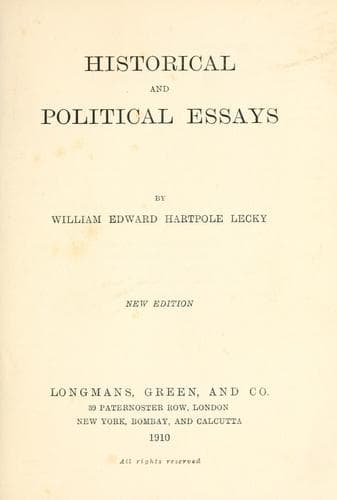
Historical and Political EssaysLecky, William Edward Hartpole
History
Historical and Political Essays
Lecky, William Edward Hartpole
History; Political science
As on the two former occasions he was in a minority, though the
temporary secession of a portion of the Liberal party gave him a
precarious power. Once more, too, he took office amid the convulsions
of a European war, for the war of Prussia and Italy with Austria had
just begun. In the new Ministry Lord Stanley was Secretary for Foreign
Affairs. In his election address he gave the keynote of his policy by
insisting in the strongest terms that England should observe a strict
neutrality in European controversies. Her vast Indian and Colonial
Empire, he said, made her a world apart and threw upon her duties and
responsibilities that taxed all her energies. She had duties also to
her poorer classes at home, whose condition was not what we could
desire; and by simply existing as a free, prosperous, and
self-governed nation, we should do more for the real freedom of Europe
than by any policy of meddling or war.
As far as his own department was concerned Lord Stanley's
administration during this short Ministry was both eminently
consistent and eminently successful. It is true that this pacific
Minister made the Abyssinian war for the release of some imprisoned
British subjects, but he only did this after every peaceful effort to
procure their release had proved abortive, and it was almost
universally recognised that there was no honourable alternative open
to him. During his ministry the Luxemburg question brought France and
Prussia to the very verge of war. It fell to the task of Lord Stanley
to mediate between them, and he did so with a success which certainly
adjourned, though it could not ultimately avert, the great catastrophe
that burst upon Europe in 1870. No success could have been more
gratifying to him, and he was fond of repeating the saying of Canning
that 'If a war must come sooner or later, for my part I prefer that it
should come later than sooner.' Lord Russell bore an ungrudging
testimony to the 'tact and discretion' Lord Stanley displayed in this
negotiation. In the same spirit he refused to take part in a
conference of European Powers which the French Emperor desired to
convene to settle the Roman question, declaring that this question was
one with which England should in no way meddle, and that a conference
would be useless and dangerous unless a basis were laid down before.
He refused to interfere in any way with the Cretan rebellion, and with
the impending disputes between Turkey and Greece. His abstention on
this question was blamed by some, but it met with the full approbation
of his great opponent, Lord Russell, who declared that 'he had acted
with much prudence and discretion.' He laid the foundation also of the
settlement of the long outstanding difficulty with America by
proposing to refer the Alabama question to arbitration, and he
negotiated a treaty on the subject, which, however, the Senate refused
to ratify.
Public-domain text, read in full here on John Shaqi.
Reviews
Reviews
No reviews yet
Be the first to share your thoughts on this work.
Elsewhere in the archive
Join the Discussion
Join the discussion
Sign in to leave a comment or review.
Sign InorCreate an account