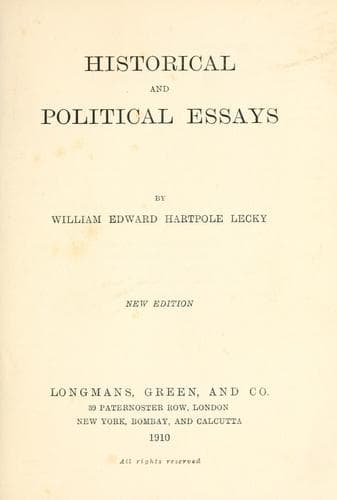
Historical and Political EssaysLecky, William Edward Hartpole
History
Historical and Political Essays
Lecky, William Edward Hartpole
History; Political science
In all this he was very consistent. The same consistency cannot be
claimed for his support of a Reform Bill far more Radical than that
which his party had so recently rejected. In my own judgment it is
impossible to defend with success the conduct of the Derby Ministry on
this question, and although Lord Stanley took only a subsidiary part
in it, he cannot escape his share of the responsibility. The
difficulty of the position of the eldest son of the Prime Minister who
was taking this 'leap in the dark' was very great, and it must be
remembered that he had long been identified with the more democratic
wing of his party. After the great agitation that followed the
downfall of the Russell Ministry, he probably regarded a democratic
measure as inevitable, and it was the character of his mind to be very
ready to accept what he considered the inevitable, and to endeavour by
timely compromise to mitigate its effects. Lord Derby's health was now
completely broken, and on February 24, 1868, he resigned office, and
Disraeli became Prime Minister.
Mr. Gladstone soon re-united the sundered sections of the Opposition
by raising the question of the Disestablishment of the Irish Church.
The resolutions asserting the expediency of this policy were
introduced into the House of Commons in April. Lord Stanley was put
forward as the principal opponent. His amendment expressed no opinion
about the merits of the proposed policy, but simply affirmed that it
was a question which ought to be reserved for a new Parliament which
was soon to be elected under an altered franchise. In his speech he
disclaimed any wish to maintain that the Irish Church Establishment
was what it ought to be, but urged that in the condition of Ireland a
merely destructive measure would do nothing but harm, that it would
serve no good purpose to attack the Establishment without laying down
the lines of a definite, constructive ecclesiastical policy, and that
it was absurd to launch such a question in the last session of an
expiring Parliament. The more ardent spirits of the Tory party
strongly censured the ambiguity of this defence, and the Government
were beaten by majorities of 56 and 60. The House of Commons was
dissolved in the autumn and a large Liberal majority returned.
Disraeli at once resigned without waiting for the assembling of
Parliament.
Public-domain text, read in full here on John Shaqi.
Reviews
Reviews
No reviews yet
Be the first to share your thoughts on this work.
Elsewhere in the archive
Join the Discussion
Join the discussion
Sign in to leave a comment or review.
Sign InorCreate an account