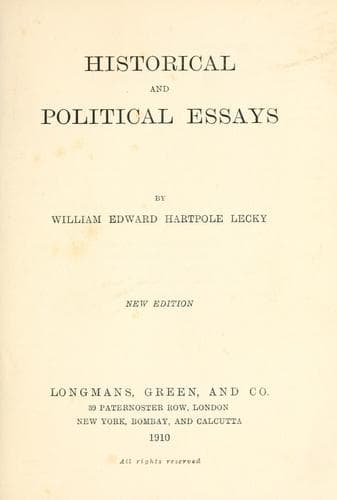
Historical and Political EssaysLecky, William Edward Hartpole
History
Historical and Political Essays
Lecky, William Edward Hartpole
History; Political science
In October 1869 the death of Lord Derby terminated the career of his
son in the House of Commons, and the following year added very greatly
to the happiness of his life by his marriage with the Dowager
Marchioness of Salisbury. His attitude in opposition is clearly shown
in his published speeches. He had no wish to see the Conservative
party again in office till they possessed an assured and homogeneous
majority, and he maintained that it should be their main object to
strengthen the influence of the more moderate section in the
Government. He believed that by habitually pursuing this policy they
would best prevent revolutionary changes, mitigate by wise compromises
measures which they did not wholly approve, secure the continuance of
the harmony of classes, on which more than on any other condition the
prosperity of England depends, and gradually strengthen their own hold
on the confidence of the country. It was also his earnest desire that
English politics should be turned as much as possible from a policy of
organic change to a policy of administrative reform. He considered it
a great evil that public men had acquired the habit of continually
tampering with the existing legislative machinery instead of wisely
using it for the benefit of the whole nation. The party system, as he
always thought, had falsified the perspective of English politics,
bringing into the foreground comparatively unimportant questions which
were well suited to rally parties and win majorities; thrusting into
the background others which were immeasurably more important, but
which were less available for party purposes. What Carlyle called 'The
Condition of England Question' was always in his thoughts. No one
would accuse him of under-rating the evils of war, but he questioned
whether the most sanguinary battle which had ever been fought carried
off nearly as many human beings as die in England every year from
purely preventible causes. He threw the whole force of his clear and
penetrating intellect into such questions as sanitary reform, the
regulation of mines, the promotion of education and especially
technical education, the organisation of charities, the treatment of
juvenile offenders, the diffusion of wise methods of encouraging
saving among the poor. The overcrowding of the great cities, and the
vast masses of insanitary dwellings, seemed to him one of the most
pressing dangers of the time, and he was a prominent member of nearly
every important company and association in England for improving the
houses of artisans. He had no puritanism in his nature and was very
anxious, by the establishment of free libraries and people's parks,
and Sunday opening of museums, to extend the range of innocent
pleasure. 'Men die,' he once said, 'for want of cheerfulness, as
plants die for want of light.' He did not believe in the repression of
drunkenness by coercive legislation like the Local Veto Bill, but he
Public-domain text, read in full here on John Shaqi.
Reviews
Reviews
No reviews yet
Be the first to share your thoughts on this work.
Elsewhere in the archive
Join the Discussion
Join the discussion
Sign in to leave a comment or review.
Sign InorCreate an account