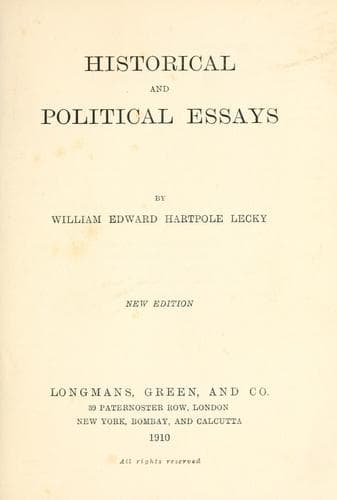
Historical and Political EssaysLecky, William Edward Hartpole
History
Historical and Political Essays
Lecky, William Edward Hartpole
History; Political science
Lord Derby had at this time to encounter much unpopularity. He was
accused of an undue leaning towards the Turkish Government, and an
inadequate sympathy with the Christian populations, and it was alleged
that if he had acted in firm concert with the other Powers in coercing
the Porte--if he had not proclaimed so loudly and constantly his
determination to abstain from all active interference and
compulsion--his remonstrances would have had more effect, and he might
have averted or restricted the calamities that had occurred. But a
great change soon took place. The first object of the Government was
to prevent the Turkish disturbance from leading to a European war, and
in this object they failed. On April 24, 1877, Russia, in spite of
English remonstrances, declared war against Turkey. On the same day a
Russian army crossed the Pruth, and the Eastern Question entered into
a new and dangerous phase.
To a statesman like Lord Derby, who maintained that war, unless it is
a necessity, is a crime; that the maintenance of peace is beyond all
comparison the greatest of British interests, the months that followed
were extremely trying. His first object was to limit the war, and to
safeguard English interests, and for this purpose he drew up on May 6,
1877, a Note defining the English interests that were vital in the
East. He warned the Russian Government that an attempt by Russia to
blockade the Suez Canal, an attack on Egypt, a Russian occupation of
Constantinople, or an alteration of the existing arrangements for the
navigation of the Bosphorus or the Dardanelles might compel England to
abandon her neutrality. Russia accepted these conditions, and for some
time there appeared every prospect of limiting the war. But in the
beginning of 1878 a period of extreme danger undoubtedly arrived.
Plevna had fallen. The Turkish resistance had collapsed. A Russian
army, flushed with victory, had advanced to near Constantinople. The
treaty of San Stephano was signed; which in the opinion of most
European statesmen placed Turkey at the feet of Russia, and Russia at
first refused to submit its terms to a conference of European Powers.
Public feeling in England now ran strongly in a direction almost
opposite to that in which it had been running eighteen months before,
and the nation was extremely alarmed at the danger of Constantinople
becoming speedily and irremediably a Russian port. On the other hand,
the national and military pride of the conquering Power was aroused,
and it was felt that a single false step, a single imprudent menace,
might lead to war.
Public-domain text, read in full here on John Shaqi.
Reviews
Reviews
No reviews yet
Be the first to share your thoughts on this work.
Elsewhere in the archive
Join the Discussion
Join the discussion
Sign in to leave a comment or review.
Sign InorCreate an account