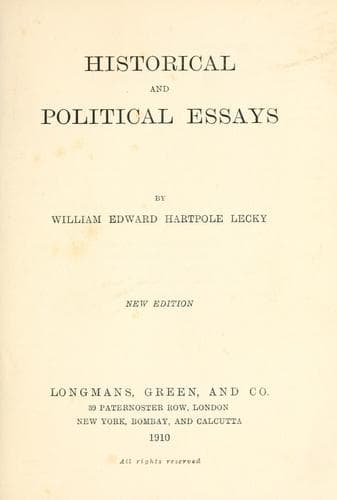
Historical and Political EssaysLecky, William Edward Hartpole
History
Historical and Political Essays
Lecky, William Edward Hartpole
History; Political science
It was one of those moments in which men's judgments are largely
affected by their temperaments, and it soon became evident that the
Cabinet was seriously divided. Disraeli had now become Lord
Beaconsfield, and sat with his Foreign Secretary in the House of
Lords. With his character it was inevitable that he should meet the
danger by a bold, decisive, and even aggressive, policy. It was no
less natural that Lord Derby should have persistently leaned towards
the side of caution and shrunk from any measure that could cut short
negotiation and diminish the chances of peace. The order given that
the British Fleet should enter the Dardanelles, first produced the
inevitable schism, and Lord Derby and Lord Carnarvon resigned. The
order was countermanded, and Lord Derby, for a short time, resumed his
post. He acquiesced, but with great reluctance, in the vote of credit
for six millions which was at once brought before the House of
Commons, but he was soon convinced that measures he did not approve of
were impending, and when orders were given for calling out the
reserves he definitely resigned.
He announced his resignation on March 28, 1878, in terms of much
dignity and moderation. He believed, he said, that his colleagues
desired peace as truly as himself, and he did not maintain that their
later measures led inevitably to war, but he considered that they were
neither necessary nor 'prudent in the interests of European peace.'
He agreed that the terms of the treaty should be submitted to a
European Congress, in which England should take part. On minor matters
he thought it his duty to waive his own opinion, but he could not do
so on a question involving the momentous issue of peace or war. The
threat involved in the last act of the Government, he said, in a later
speech, would make it more difficult for Russia to modify her policy,
and he believed that without a threat such a modification of the
treaty of San Stephano could be obtained as would make it acceptable.
He had been accused of indecision and even of cowardice. For his own
part he thought it needed more courage to stand up in his place to
express views which he knew to be unpopular among the great body of
his friends, than to sit at a desk in Downing Street and issue orders
which would bring no danger or unpopularity to himself, but might
bring about a European war.
The short speech in which Lord Beaconsfield accepted the resignation,
and dwelt on the long friendship, personal as well as political, that
bound him to Lord Derby, seems to me a perfect model of good feeling
and good taste. Unfortunately the example of the Prime Minister was
not followed, and words used in a later debate went far to make the
breach irrevocable.
Public-domain text, read in full here on John Shaqi.
Reviews
Reviews
No reviews yet
Be the first to share your thoughts on this work.
Elsewhere in the archive
Join the Discussion
Join the discussion
Sign in to leave a comment or review.
Sign InorCreate an account