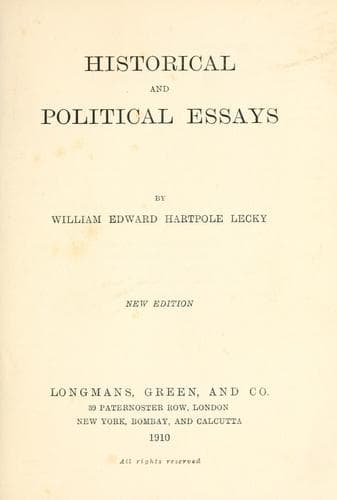
Historical and Political EssaysLecky, William Edward Hartpole
History
Historical and Political Essays
Lecky, William Edward Hartpole
History; Political science
It was a task for which he was eminently suited. The qualities which
most impressed all who came into close communication with him were the
strength, swiftness, and soundness of his judgment, and his unfailing
tact and discretion in dealing with delicate questions. He was
eminently a man of the world, and had quite as much knowledge of men
as of books. Probably few men of his time have been so frequently and
so variously consulted. He always spoke with confidence and authority,
and his clear, keen-cut, decisive sentences, a certain stateliness of
manner which did not so much claim as assume ascendancy, and a
somewhat elaborate formality of courtesy which was very efficacious in
repelling intruders, sometimes concealed from strangers the softer
side of his character. But those who knew him well soon learnt to
recognise the genuine kindliness of his nature, his remarkable skill
in avoiding friction, and the rare steadiness of his friendships.
One great source of his influence was the just belief in his complete
independence and disinterestedness. For a very able man his ambition
was singularly moderate. As he once said, he had made it his object
throughout life only to aim at things which were well within his
power. He had very little respect for the judgment of the multitude,
and he cared nothing for notoriety and not much for dignities. A
moderate competence, congenial work, a sphere of wide and genuine
influence, a close and intimate friendship with a large proportion of
the guiding spirits of his time, were the things he really valued, and
all these he fully attained. He had great conversational powers, which
never degenerated into monologue, a singularly equable, happy, and
sanguine temperament, and a keen delight in cultivated society. These
characteristics showed conspicuously in two small and very select
dining-clubs which have included most of the distinguished English
statesmen and men of letters of the century. He became a member of the
Literary Society in 1857 and of Dr. Johnson's Club in 1861, and it is
a remarkable evidence of the appreciation of his social tact that both
bodies speedily selected him as their treasurer. He held that position
in 'The Club' from 1868 till within a year of his death, when failing
health and absence from London obliged him to relinquish it. The
French Institute elected him 'Correspondant' in 1863 and Associated
Member in 1888, in which latter dignity he succeeded Sir Henry Maine.
In 1869 the University of Oxford conferred on him the honorary degree
of D.C.L.
Public-domain text, read in full here on John Shaqi.
Reviews
Reviews
No reviews yet
Be the first to share your thoughts on this work.
Elsewhere in the archive
Join the Discussion
Join the discussion
Sign in to leave a comment or review.
Sign InorCreate an account