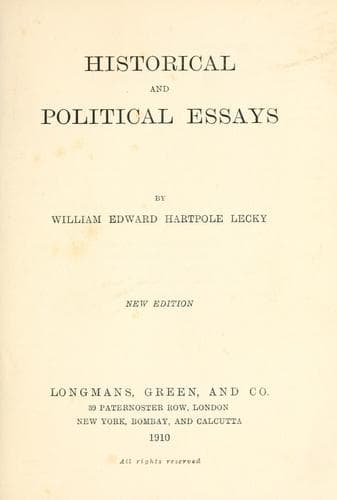
Historical and Political EssaysLecky, William Edward Hartpole
History
Historical and Political Essays
Lecky, William Edward Hartpole
History; Political science
It was in 1855, on the death of Sir George Cornewall Lewis, that he
assumed the editorship of the 'Edinburgh Review' which he retained
till the day of his death. Both on the political and the literary side
he was in full harmony with its traditions. His rare and minute
knowledge of recent English and foreign political history; his vast
fund of political anecdote; his personal acquaintance with so many of
the chief actors on the political scene, both in England and France,
gave a great weight and authority to his judgments, and his mind was
essentially of the Whig cast. He was a genuine Liberal of the school
of Russell, Palmerston, Clarendon, and Cornewall Lewis. It was a sober
and tolerant Liberalism, rooted in the traditions of the past, and
deeply attached to the historical elements in the Constitution. The
dislike and distrust with which he had always viewed the progress of
democracy deepened with age, and it was his firm conviction that it
could never become the permanent basis of good government. Like most
men of his type of thought and character, he was strongly repelled by
the later career of Mr. Gladstone, and the Home Rule policy at last
severed him definitely from the bulk of the Liberal party. From this
time the present Duke of Devonshire was the leader of his party.
His literary judgments had much analogy to his political ones. His
leanings were all towards the old standards of thought and style. He
had been formed in the school of Macaulay and Milman, and of the great
French writers under Louis Philippe. Sober thought, clear reasoning,
solid scholarship, a transparent, vivid, and restrained style were the
literary qualities he most appreciated. He was a great purist,
inexorably hostile to a new word. In philosophy he was a devoted
disciple of Kant, and his decided orthodoxy in religious belief
affected many of his judgments. He could not appreciate Carlyle; he
looked with much distrust on Darwinism and the philosophy of Herbert
Spencer and he had very little patience with some of the moral and
intellectual extravagances of modern literature. But, according to his
own standards and in the wide range of his own subjects, his literary
judgment was eminently sound, and he was quick and generous in
recognising rising eminence. In at least one case the first
considerable recognition of a prominent historian was an article in
the 'Edinburgh Review' from his pen.
He had a strong sense of the responsibility of an editor, and
especially of the editor of a Review of unsigned articles. No article
appeared which he did not carefully consider. His powerful
individuality was deeply stamped upon the Review, and he carefully
maintained its unity and consistency of sentiments. It was one of the
chief occupations and pleasures of his closing days, and the very last
letter he dictated referred to it.
Public-domain text, read in full here on John Shaqi.
Reviews
Reviews
No reviews yet
Be the first to share your thoughts on this work.
Elsewhere in the archive
Join the Discussion
Join the discussion
Sign in to leave a comment or review.
Sign InorCreate an account