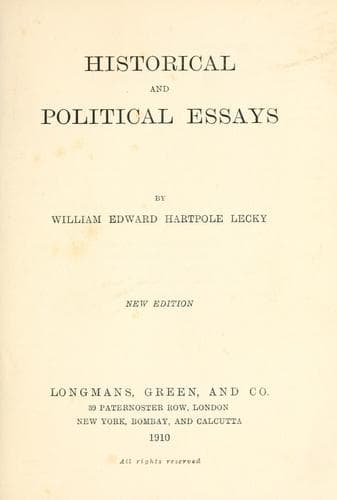
Historical and Political EssaysLecky, William Edward Hartpole
History
Historical and Political Essays
Lecky, William Edward Hartpole
History; Political science
thought to unwelcome conclusions. He often took refuge from them in
clouds of casuistry. The scepticism which was a marked feature of his
intellect allied itself closely with credulity, for it was directed
against reason itself; and though he has expressed in admirable
language many true and beautiful thoughts, the glamour of his style
too often concealed much weakness and uncertainty of judgment and much
sophistry in argument.
Many of those who co-operated with him were men of great learning and
distinguished ability. No one will question the patristic knowledge of
Pusey, the metaphysical acumen of Ward, the genuine vein of religious
poetry in Keble and Faber, the wide accomplishments and scholarly
criticism of Church. But on the whole the broad stream of English
thought has gone in other directions. In politics the Oxford movement
had brilliant representatives in Gladstone and Selborne, but the ideal
of the relations of Church and State and the ideal of education to
which the Oxford school aspired, have been absolutely discarded. The
universities have been secularised. The Irish Established Church,
which it was one of the first objects of the party to defend, has been
abolished by Gladstone himself, and although the English Established
Church retains its hold on the affections of the nation, it is
defended by its most skilful supporters on very different grounds and
by very different arguments from those which were put forward by the
Oxford divines. Among the foremost names in lay literature during the
fifty years we are considering, it is curious to observe how few were
even touched by the movement. Froude is an exception, but he speedily
repudiated it. The mediæval sympathies that were sometimes shown by
Ruskin sprang from a wholly different source. Macaulay, Carlyle,
Hallam, Grote, Mill, Buckle, Tennyson, Browning, and the great
novelists, from Dickens to George Eliot, all wrote very much as they
might have written if the movement had never existed. An unusual
proportion of the best intellect of England passed into the fields of
physical science, and the methods of reasoning and habits of thought
which they inculcated were wholly out of harmony with the school of
Newman, while both geology and Darwinism have made serious incursions
into long-cherished beliefs. Even in the Church itself, though the
High Church movement was stronger than any other, great deductions
have to be made. The school of independent Biblical criticism, which
in various degrees has come to be generally accepted, certainly owed
nothing to it, and several of the most illustrious Churchmen of this
period were wholly alien to it. Thirlwall and Merivale were
conspicuous examples, but they devoted themselves chiefly to great
works of secular history. Arnold--who was one of the strongest
personal influences of his age, and whose influence was both
perpetuated and widened by Dean Stanley--and Whately, who was one of
Public-domain text, read in full here on John Shaqi.
Reviews
Reviews
No reviews yet
Be the first to share your thoughts on this work.
Elsewhere in the archive
Join the Discussion
Join the discussion
Sign in to leave a comment or review.
Sign InorCreate an account