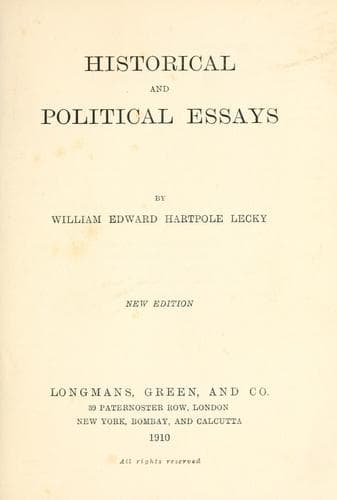
Historical and Political EssaysLecky, William Edward Hartpole
History
Historical and Political Essays
Lecky, William Edward Hartpole
History; Political science
the most independent and original thinkers of the nineteenth century,
were strongly antagonistic. In the field of ecclesiastical history it
might have been expected that a school which was at once so scholarly
and so wedded to tradition would have been pre-eminent, but no
ecclesiastical histories which England has produced can, on the whole,
be placed on as high a level as those which were written by the great
Broad Church divine whose name stands at the head of this article.
Milman was, indeed, a man well deserving of commemoration on account
of the works which he produced, yet it is perhaps not too much to say
that to those among whom he lived the man seemed even greater than his
works. For many years he was a central and most popular figure in the
best English literary society, and he reckoned most of the leading
intellects of his day among his friends. He was in an extraordinary
degree many-sided, both in his knowledge and his sympathies. He was an
admirable critic, and the eminent sanity of his judgment, as well as
the eminent kindness of his nature, combined with a great charm both
of manner and of conversation. Few men of his time had more friends,
and were more admired, consulted, and loved.
Mr. Arthur Milman has sketched his father's life in one short
volume,[48] written in excellent English and with uniformly good
taste. We have read it with much interest, yet in laying it down it is
impossible not to be sensible how much of the personal charm which was
so conspicuous in its subject has passed beyond recovery. More than
thirty years have gone by since the old Dean was laid in his grave,
and but few of those who knew him intimately survive. He appears to
have kept no journal. He wrote nothing autobiographical, and he had a
strong sense of the chasm that should separate private from public
life. It was wholly contrary to his unegotistical nature to make the
great public the confidant of his domestic affairs or of his inner
feelings, and he was deeply sensible of the injustice which is so
often done by biographers in printing unguarded, unqualified opinions
and judgments, expressed in the freedom of private correspondence. He
acted sternly on this view. Many of the foremost men in England were
among his correspondents, but he deliberately burnt their letters. 'I
could never bear,' we have heard him say, 'that what was written to me
by dear friends in the most unreserved and absolute confidence should,
through my fault, be one day dragged before the public.' This
reticence and this strong feeling of the sanctity of friendship and
private correspondence, which is now becoming very rare, was one of
his most characteristic traits, but it has necessarily deprived his
biography of many elements of interest.
Public-domain text, read in full here on John Shaqi.
Reviews
Reviews
No reviews yet
Be the first to share your thoughts on this work.
Elsewhere in the archive
Join the Discussion
Join the discussion
Sign in to leave a comment or review.
Sign InorCreate an account