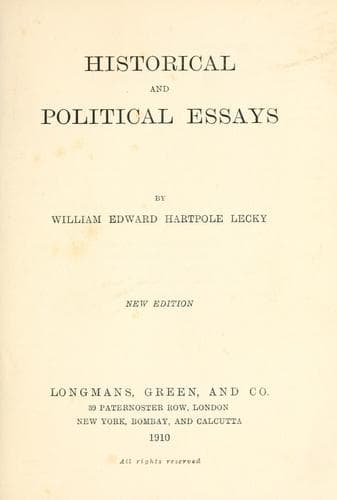
Historical and Political EssaysLecky, William Edward Hartpole
History
Historical and Political Essays
Lecky, William Edward Hartpole
History; Political science
He was the youngest son of Sir Francis Milman, the well-known
physician of George III. He was born in 1791, and educated at Eton and
Oxford, where he soon distinguished himself as one of the most
brilliant of students. He won the Newdigate in 1812, the Chancellor's
prize for Latin verse in 1813, the prize for English and Latin essays
in 1816. He obtained a first class in classics, and in 1815 he was
elected a Fellow of his college. He was ordained in the following
year, and a year later Lord Eldon, who was then Chancellor of the
university, nominated him to the vicarage of St. Mary at Reading,
where he spent eighteen happy and fruitful years. Like most young and
brilliant men, he first turned to verse, and for several years he
poured out in rapid succession a number of dramas and poems which have
been collected in three substantial volumes. The tragedy of 'Fazio'
was written when he was still at Oxford, and it was speedily followed
by a long and ambitious epic poem called 'Samor, Lord of the Bright
City'; by three elaborate sacred dramas, the 'Fall of Jerusalem,' the
'Martyr of Antioch,' and 'Belshazzar'; and by an historical tragedy on
'Anne Boleyn,' as well as by a few minor poems.
Some of these works had considerable popularity. 'Fazio' for many
years held its place on the stage. Byron, in one of his letters to
Rogers, speaks of its 'great and deserved success' when it was brought
out at Covent Garden. Its heroine was a favourite part of Miss O'Neil
and of Fanny Kemble. It was translated into Italian by Del Ongaro for
Ristori, who acted it with admirable power, and there was also a
French translation or adaptation in which Mademoiselle Mars took part.
The 'Fall of Jerusalem' was never intended for the stage, but it had a
great literary success. Murray, who had given only a hundred and fifty
guineas for 'Fazio,' gave five hundred for the 'Fall of Jerusalem,'
and he gave the same sum both for the 'Martyr of Antioch' and for
'Belshazzar,' which succeeded it. Neither of these, however, proved as
popular as the 'Fall of Jerusalem,' but the 'Martyr of Antioch'
contains that noble funeral ode beginning 'Brother, thou art gone
before us, and thy saintly soul is flown,' which is familiar to
numbers who are probably not aware of its authorship. It is worthy of
notice that as recently as 1880 Sir Arthur Sullivan set the 'Martyr of
Antioch' to music and brought it out at the Leeds Festival, where it
achieved an immediate and brilliant success, and was frequently
performed.[49] On the other hand, 'Samor' and 'Anne Boleyn' were
almost absolute failures, and, on the whole, the longer poems of
Milman have not retained their popularity, and probably now rarely
find a reader.
Public-domain text, read in full here on John Shaqi.
Reviews
Reviews
No reviews yet
Be the first to share your thoughts on this work.
Elsewhere in the archive
Join the Discussion
Join the discussion
Sign in to leave a comment or review.
Sign InorCreate an account