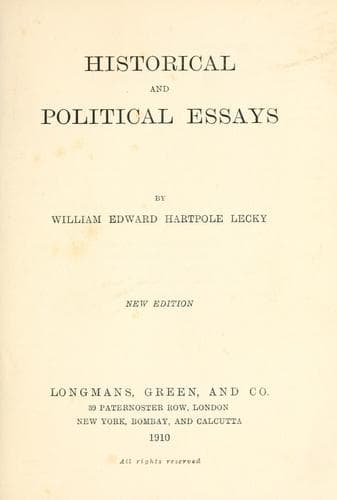
Historical and Political EssaysLecky, William Edward Hartpole
History
Historical and Political Essays
Lecky, William Edward Hartpole
History; Political science
Provost Hawtrey, who was no mean judge of men, said, after an intimacy
of nearly fifty years, that he had never known a man who possessed in
a greater degree than Milman the virtue of Christian charity in its
highest and rarest form. It was a gift which stood him in good stead
in dealing with the very blended characters, the tangled politics, the
often misguided enthusiasms of ecclesiastical history. While he was
constitutionally extremely averse to the moral casuistry which
confuses the boundaries of right and wrong, he had too sound a grasp
of the evolution of history to fall into the common error of judging
the acts of one age by the moral standards of another. His history was
eminently a history of large lines and broad tendencies. The growth,
influence, and decline of the Papacy--the distinctive characteristics
of Latin and Teutonic Christianity; the effect of Christianity on
jurisprudence; the monastic system in its various phases; the rise and
conquests of Mohammedanism; the severance of Greek from Latin
Christianity; Charlemagne, Hildebrand, the Crusades, the Templars, the
Great Councils; the decay of Latin and the rise of modern languages;
the influence of the Church on literature, painting, sculpture, and
architecture--are but a few of the great subjects he has treated,
always with knowledge and intelligence, often with conspicuous
brilliancy.
In so vast a field there were, no doubt, many subjects which have been
treated with a greater fulness and completeness by other writers.
There are some in which subsequent research has gone far to supersede
what Milman has written, and inaccuracies of detail not unfrequently
crept into his work; but in the truthfulness of its broad lines, in
the sagacity of its estimates both of men and events, it holds a high
place among the histories of the world. Very few historians have
combined in a larger measure the three great requisites of knowledge,
soundness of judgment, and inexorable love of truth. The growth and
modifications of doctrines and the minutiæ of religious controversies
were, however, subjects in which he took little interest, and though
they could not be excluded from an ecclesiastical history, they are
dealt with only in a slight and cursory manner. Those who desire to
study in detail this side of ecclesiastical history will find other
histories much more useful. It has been said that his work is
imperfect as a book of reference, for while the great events and
personages are discussed with a fulness that leaves little to be
desired, many of the more insignificant transactions or more obscure
periods are passed over or barely noticed. Critics of different
religious schools have also complained that his mind was essentially
secular; that he had a low sense of the certainty and the importance
of dogma; that there were some classes of ecclesiastical writers who
have been deeply revered in the Church with whom he had no real
Public-domain text, read in full here on John Shaqi.
Reviews
Reviews
No reviews yet
Be the first to share your thoughts on this work.
Elsewhere in the archive
Join the Discussion
Join the discussion
Sign in to leave a comment or review.
Sign InorCreate an account