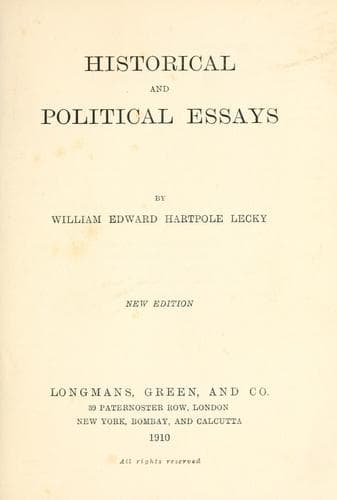
Historical and Political EssaysLecky, William Edward Hartpole
History
Historical and Political Essays
Lecky, William Edward Hartpole
History; Political science
sympathy; that the spirit of criticism was stronger in his book than
the spirit of reverence; that he did not do full justice to the
spiritual and inner side of the religion he described. He looked upon
it, they said, too externally. He valued it as a moral revolution, the
introduction of new principles of virtue and new rules for individual
and social happiness. Much of this criticism would probably have been
accepted with but little qualification by Milman himself. He would
have said that what these writers complained of was in the main
inseparable from an historical as distinguished from a devotional
treatment of his subject. He would have added that no form of human
history reveals so clearly as ecclesiastical history the fallibility,
the credulity, the intolerance of the human mind, or requires more
imperatively the constant exercise of independent judgment and of
fearless and unsparing criticism, and that, if the history of the
Church is ever to be written with profit, it must be written in such a
spirit. Of his own deeper convictions he seldom spoke; but in the
concluding page of his 'Latin Christianity' there is a passage of
profound interest. Leaving it, as he says, to the future historian of
religion to say what part of the ancient dogmatic system may be
allowed to fall silently into disuse, and what transformations the
interpretation of the Sacred Writings may still undergo, he adds these
significant words:
'As it is my own confident belief that the words of Christ, and his
words alone (the primal indefeasible truths of Christianity), shall
not pass away, so I cannot presume to say that men may not attain to a
clearer, at the same time more full, comprehensive, and balanced sense
of those words, than has as yet been generally received in the
Christian world. As all else is transient and mutable, these only
eternal and universal, assuredly whatever light may be thrown on the
mental constitution of man, even on the constitution of nature and the
laws which govern the world, will be concentered so as to give a more
penetrating vision of those undying truths.... Christianity may yet
have to exercise a far wider, even if more silent and untraceable
influence, through its primary, all-pervading principles, on the
civilisation of mankind.'
Public-domain text, read in full here on John Shaqi.
Reviews
Reviews
No reviews yet
Be the first to share your thoughts on this work.
Elsewhere in the archive
Join the Discussion
Join the discussion
Sign in to leave a comment or review.
Sign InorCreate an account