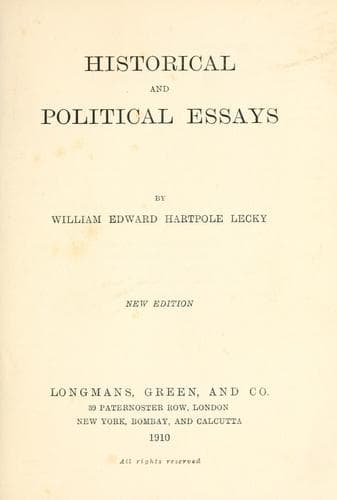
Historical and Political EssaysLecky, William Edward Hartpole
History
Historical and Political Essays
Lecky, William Edward Hartpole
History; Political science
The widely different tone which was adopted by Lord Clarendon and Lord
Granville, the open breach between Palmerston and Lord John Russell on
account of the way in which the former conducted his foreign policy
without consultation with the Cabinet, and the refusal of Lord Grey,
in a most critical moment, to take office in a Government in which
Lord Palmerston held the seals of the Foreign Office, show how fully
in this respect the sentiments of the Queen accorded with those of
many of Lord Palmerston's own colleagues. But in addition to mere
questions of manner and procedure, there was much in the substance of
the policy of Palmerston to which the Queen objected. Her dislike to
the Revolutionary element on the Continent, which Lord Palmerston
either encouraged or viewed with indifference, her sympathy with the
old governments and dynasties, that were so gravely shaken in the year
of the Revolution, were very marked. In the disputes between Germany
and Denmark on the Schleswig-Holstein question her sympathies, unlike
those of her people, were decidedly with Germany, and although she was
fully sensible of the misgovernment of some of the Italian States, she
was not favourable to that cause of Italian unity which Lord John
Russell and Lord Palmerston so strenuously upheld. Her nature, which
was very frank, made it impossible for her, even if she desired it, to
conceal her opinions, and she devoted much time and pains to making
herself acquainted with the details of every question as it arose. She
made it a rule to sign no paper that she had not read. She did not
hesitate fully to apprise her Ministers of her views when they
differed from their own, and she enforced her views by argument and
remonstrance. She more than once drew up memoranda of her dissent from
the opinions of her Foreign Minister, and insisted on their being
brought before the Cabinet for consideration. In the formation of a
new Ministry she more than once exercised her power of deciding to
whom the succession of the first places should be offered. After an
adverse vote of the House of Commons, she considered herself fully
authorised to decide whether she would accept the resignation of a
Minister or submit the issue to the test of a dissolution, and there
were occasions on which she remonstrated with her Ministers on their
too ready determination to resign.
Public-domain text, read in full here on John Shaqi.
Reviews
Reviews
No reviews yet
Be the first to share your thoughts on this work.
Elsewhere in the archive
Join the Discussion
Join the discussion
Sign in to leave a comment or review.
Sign InorCreate an account