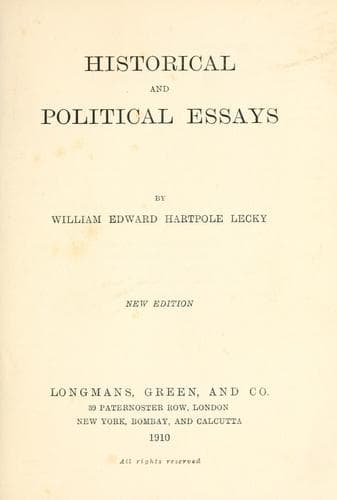
Historical and Political EssaysLecky, William Edward Hartpole
History
Historical and Political Essays
Lecky, William Edward Hartpole
History; Political science
At the same time it is certain that the Queen fulfilled with
perfection that most difficult duty of an able constitutional
Sovereign--the duty of yielding her convictions to those of her
responsible Ministers and acting faithfully with Ministers she
distrusted. To a Sovereign with clear views and a more than common
force of character this must often have been very painful, and to have
fulfilled it faithfully and with no loss of dignity is no small merit.
It is the universal testimony of all who served her, that no Sovereign
ever supported her successive Ministers with a more perfect loyalty or
held the scales between contending parties with a more complete
impartiality. No one understood better to what point a constitutional
Sovereign may press her opinions and at what point she is bound to
give way; and while maintaining her rightful authority she never in
any degree transgressed its bounds. In the very beginning of her reign
she showed this quality in a high degree. She looked up to Lord
Melbourne with an almost filial affection, and there were peculiar
reasons why his great opponent, Sir Robert Peel, should have been
distasteful to her. The dispute about the removal of her Ladies of the
Bedchamber, and still more the conduct of Sir Robert Peel in
supporting the reduction of the income which the Whigs had proposed
for Prince Albert, must have touched her feelings on the most
sensitive points, and the stiff, formal, somewhat awkward manner of
Peel seemed very little fitted to ingratiate him with a young
Sovereign. Yet when the change of Ministry arrived, Peel found no
trace of resentment in the Queen. She gave him her complete
confidence, and she fully estimated his great qualities. Of all the
Ministers who served her there is indeed none of whom she has written
in warmer terms. When Lord Palmerston became Prime Minister in 1855 it
was contrary to her earnest desire, but when the change was made
Palmerston himself acknowledged that he had 'no reason to complain of
the least want of cordiality or confidence on the part of the Court.'
At the time when she was most opposed to her Ministers, she fully
acquiesced in the principle that she must submit all letters on public
affairs to them and frame her replies upon their advice. There were
constant attempts on the part of foreign Sovereigns who were connected
with her to carry on affairs by correspondence with her without the
knowledge and sanction of her Ministers, but the Queen steadily
resisted them. Anything, indeed, that in any way savoured of intrigue
was in the highest degree repugnant to her nature.
Public-domain text, read in full here on John Shaqi.
Reviews
Reviews
No reviews yet
Be the first to share your thoughts on this work.
Elsewhere in the archive
Join the Discussion
Join the discussion
Sign in to leave a comment or review.
Sign InorCreate an account