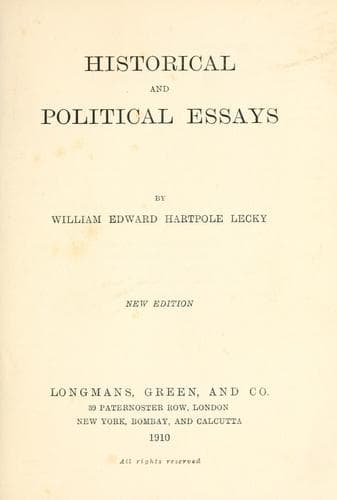
Historical and Political EssaysLecky, William Edward Hartpole
History
Historical and Political Essays
Lecky, William Edward Hartpole
History; Political science
She acted in the same way in internal affairs. Few measures that were
carried in her time were more repugnant to her than Gladstone's
disestablishment of the Irish Church. It abolished an institution of
which she was herself the head and which a special clause in the
Coronation Oath required her to uphold, and she foretold, not without
good reason, that it would not pacify Ireland but would be an
encouragement to further agitation. The question, however, had been
submitted at a general election to the decision of the country, and
after that decision had been unequivocally given in favour of the
policy of Gladstone, she frankly accepted it with the assent of the
Prime Minister. When a great danger of a conflict between the two
Houses of Parliament had arisen, she devoted herself actively in
preventing it. She employed for that service the instrumentality of
Archbishop Tait--a great statesman-prelate, whose promotion to the see
of Canterbury was due to her own personal initiative, contrary to the
wish of Lord Beaconsfield, but most fully justified by the result--and
it was largely due to the intervention of the Queen that the Church
Bill was not thrown out in the House of Lords. She acted in a
somewhat similar way with reference to the Franchise Bill of 1884,
though on this occasion she does not seem to have disliked the
measure, which she urged the House of Lords to accept.
On three very memorable occasions the intervention of the Queen had
probably a great effect on English politics. It is well known that at
the time when the issue of peace or war with the United States was
trembling in the balance on account of the seizure of the Southern
envoys on the 'Trent,' the Queen, acting in accordance with the Prince
Consort, by softening and revising the language of an English despatch
to America, did very much to prevent the dispute from leading to a
great war; that in the proclamation which was issued to the Indian
people after the Sepoy Mutiny, she insisted on the excision of some
most unfortunate words that seemed to menace the native creeds, and on
the insertion of an emphatic promise that they should in no wise be
interfered with, and thus probably prevented a new outburst of most
dangerous fanaticism; that at the time of the Schleswig-Holstein
dispute she contributed powerfully and actively to give a turn to the
negotiations that averted a war with Prussia and Austria, which, as is
now almost universally recognised, could only have led to a great
catastrophe.
Public-domain text, read in full here on John Shaqi.
Reviews
Reviews
No reviews yet
Be the first to share your thoughts on this work.
Elsewhere in the archive
Join the Discussion
Join the discussion
Sign in to leave a comment or review.
Sign InorCreate an account