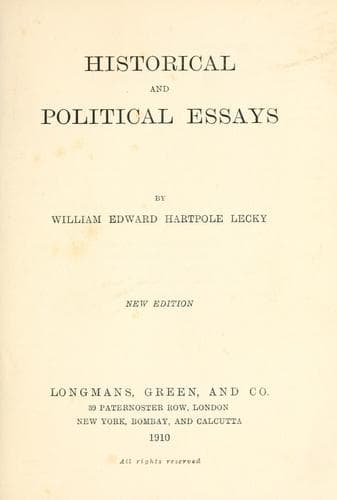
Historical and Political EssaysLecky, William Edward Hartpole
History
Historical and Political Essays
Lecky, William Edward Hartpole
History; Political science
Her religious opinions were brought very little before the public.
Beyond a deep sense of Providential guidance and of the comforting
power of religion, little is to be gathered from her published
utterances; but she seemed equally at home in the Scotch Presbyterian
and the Anglican Episcopal Church, and her marked admiration for such
men as Dean Stanley and Norman Macleod, and for the preaching of
Principal Caird, gives some clue to the bias of her opinions. Her mind
was not speculative but eminently practical, and while she patronised
good works of the most various kinds, there is reason to believe that
those which most appealed to her personal feelings were those which
directly contributed to alleviate the sufferings, or promote the
material welfare, of the poor. She devoted the greater part of her
Jubilee present to institutions for providing nurses for the sick
poor, and this is said to have been one of the charities in which she
took the warmest and most constant interest.
She is said not to have had any sympathy with the movement for the
extension of political power to women, which became so conspicuous in
her reign; but her own success in filling for sixty-three years the
highest political position in the nation will always be quoted in its
support. Considering, indeed, how comparatively small has been the
number of reigning female Sovereigns, it is remarkable how many in
modern times have shown themselves pre-eminently capable. Isabella of
Spain, Catherine of Russia, Maria Theresa of Austria, and our own
Elizabeth, all rise far above the level of ordinary Sovereigns. Some
of these seem figures of a larger and stronger mould than Queen
Victoria, but they governed under very different constitutional
conditions, and, with one exception, there are serious blots on their
memory. There are few sadder facts in history than that the pure and
tender-hearted Spanish Queen should have been deeply tinged with the
persecuting fanaticism of her age and country; that she should have
consented to the establishment of the Inquisition in Castile, to the
expulsion of the Moors from her dominions, to the first law in Europe
establishing a practical censorship of the Press. The unscrupulous
ambition, the shameless favouritism, the gross personal vices of
Catherine, are as conspicuous as her high intelligence, her
indomitable will, her majestic commanding power. The reign of
Elizabeth is perhaps the most glorious in English history, but the
character of that great Queen is lamentably tarnished by waywardness
and caprice. Among purely constitutional Sovereigns Queen Anne holds a
respectable, though certainly not a brilliant, place, and it may be
added that much of the merit of the very constitutional though not
very glorious reign of George II. is due to the excellent sense and
judgment of Queen Caroline. In spite of the saying of Burke, the age
of chivalry is not wholly dead. The sex of Queen Victoria no doubt
Public-domain text, read in full here on John Shaqi.
Reviews
Reviews
No reviews yet
Be the first to share your thoughts on this work.
Elsewhere in the archive
Join the Discussion
Join the discussion
Sign in to leave a comment or review.
Sign InorCreate an account