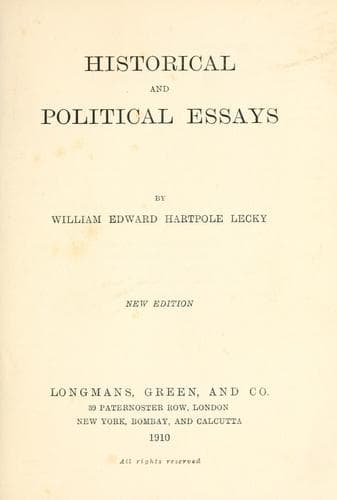
Historical and Political EssaysLecky, William Edward Hartpole
History
Historical and Political Essays
Lecky, William Edward Hartpole
History; Political science
gave an additional touch of warmth to the loyalty of her people, and
many of the qualities that made her most popular are intensely, if not
distinctively, feminine. They would not, however, have given her the
place she will always hold in English history, if they had not been
united with what men are accustomed to regard as more peculiarly
masculine--a clear, well-balanced mind, singularly free from
fanaticisms and exaggerations, excellently fitted to estimate rightly
the true proportion of things.
In the last years of her reign the political horizon greatly cleared.
Lord Beaconsfield, during his later Ministries, obtained not only her
fullest political confidence, but also won a warmer degree of personal
friendship than she had bestowed on any Minister since the death of
Lord Melbourne; and her relations with his successor, Lord Salisbury,
appear to have been perfectly harmonious. The decisive rejection by
the country of the Home Rule policy removed a great incubus from her
mind, and she was fully in harmony with the strong Imperialist
sentiments which now began to prevail in English thought, and
especially with the warmer feeling towards our distant colonies which
was one of its chief characteristics. Her own popularity also rapidly
grew. She had keenly felt and bitterly resented the reproaches which
had at one period been frequently brought against her for her neglect
of social and ceremonial duties during many years of her widowhood.
Her censors, she maintained, made no allowance for her loneliness, her
advancing years, her feeble health, the overwhelming and incessant
pressure of her more serious political duties. But her two Jubilees,
bringing her once more into close touch with her people, put an end to
these reproaches. The Queen found with pleasure and perhaps with
surprise how capable she still was of performing great public
functions, and the vast outburst of spontaneous loyalty and affection
of which she became the object gave her deep and unconcealed pleasure.
To those, however, who were closely in connection with her it was
touching to observe the gracious and unaffected modesty with which she
received the homage of her subjects. Flattery was one of the things
she disliked the most, and all who knew her best were struck with the
singularly modest view she always took of herself. But blending with
this modesty, and even with a shyness which she never wholly
conquered, was the craving of a deeply affectionate and womanly nature
for sympathy, and this craving was now abundantly gratified.
Public-domain text, read in full here on John Shaqi.
Reviews
Reviews
No reviews yet
Be the first to share your thoughts on this work.
Elsewhere in the archive
Join the Discussion
Join the discussion
Sign in to leave a comment or review.
Sign InorCreate an account