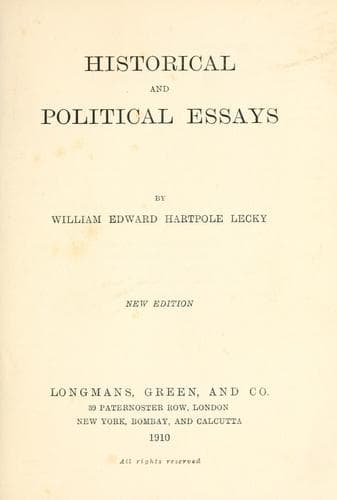
Historical and Political EssaysLecky, William Edward Hartpole
History
Historical and Political Essays
Lecky, William Edward Hartpole
History; Political science
At the same time the doctrine has arisen, and is now sedulously
propagated in England, that the State ought to undertake to provide at
the public expense for all old persons, or at least for all deserving
old persons, who have not succeeded in obtaining a sufficient
livelihood for themselves; that this provision should not be regarded
as an eleemosynary grant, but as a positive right; and that, in order
to free it from the taint of pauperism, and take away from the
recipient all reluctance to receive it, a new fund should be created,
entirely distinct from poor-law relief, and administered by some other
tribunal than the poor-law guardians.
The claim has been supported on another ground. The immense
improvement of the material condition of the English working classes
during the last half-century is beyond all question; but it is much
more evident among the young and the strong than among the old. The
intense competition of modern industry, stimulated to the highest
point by free trade, by the factory system, and by the vast
development of machinery, has expelled the old and feeble from some of
its most important fields; and the influence of trade-unions in
enforcing, in each trade which they can control, a uniform and minimum
wage, has obliged the employer to employ only the most efficient
labour.
The old man who could once easily obtain a little work at low wages
now finds it much more difficult; and the recent legislation
compelling the employer to compensate his workmen for all accidents
that take place in his employment, even when those accidents are in no
degree due to any negligence on his own part or on that of his
servants, has acted in the same direction. Such serious obligations
have been thrown on the employer in the more dangerous trades, that he
is obliged in self-defence to restrict himself to the workmen who are
least liable to accidents; and they are naturally those whose
strength, activity, and eyesight are at their best. Among the
recipients of poor-law relief the proportion of men over sixty-five is
enormously great; and some figures which, in 1893, were brought before
the Commission on the Aged Poor, made a great impression on the
country. It was stated that in a single year 29.3 of the whole
population over sixty-five were in receipt of poor-law relief in
England and Wales; and assuming that a third part of these old persons
belonged to the well-to-do, it was calculated that not much less than
three in seven must fall into the ranks of pauperism.
Public-domain text, read in full here on John Shaqi.
Reviews
Reviews
No reviews yet
Be the first to share your thoughts on this work.
Elsewhere in the archive
Join the Discussion
Join the discussion
Sign in to leave a comment or review.
Sign InorCreate an account