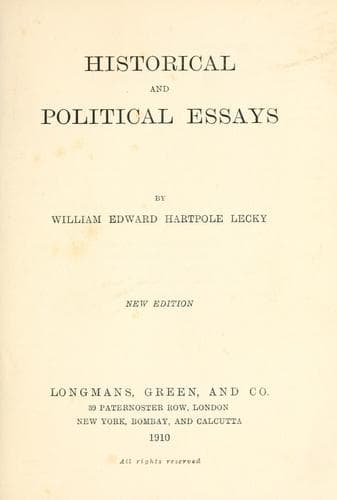
Historical and Political EssaysLecky, William Edward Hartpole
History
Historical and Political Essays
Lecky, William Edward Hartpole
History; Political science
It would certainly be a great exaggeration to say that these
principles have disappeared. Indeed, the robust, independent,
self-respecting character which it was the object of the Manchester
School to encourage is abundantly displayed in the gigantic Friendly
and other working-class Co-operative Societies which have so largely
increased in England during the last half-century. Two of these
Friendly Societies--the Manchester Unity and the Foresters--have each
of them more than seven hundred thousand members on their roll. At the
same time, it is equally certain that in many quarters a different,
and, in my opinion, very dangerous, spirit prevails. In England as
elsewhere there is an increased tendency to aggrandise the functions
of the State and to look to State aid or State control rather than
individual or co-operative effort as the remedy of every evil. Social
questions have assumed a greater prominence in politics; and, with the
lowering of the franchise, the vague State Socialism, which, in
different degrees, pervades most working-class politics, has given a
bias to both parties in the State. It has become prominent in every
election and has produced many rash pledges.
The close connection between taxation and representation, which was
once considered the cardinal principle of English Liberalism, has, in
a marked degree, diminished, both in Imperial and local taxation. It
used to be contended that those who chiefly paid should chiefly
regulate, and that taxation should be as much as possible the
voluntary grant of the taxpayers, restricted to their common purposes.
But in many quarters a different belief has grown up. It is held that
in the hands of a democracy taxation should be made the means of
redressing the inequalities of fortune, ability, or industry; the
preponderant class voting and spending money which another class are
obliged to pay. The income-tax is so arranged that a large majority of
the voters are exempt from its burden; a highly graduated system of
death duties is now nearly the most prominent of our Imperial taxes;
and the Local Government Act of 1894 has placed local taxation on the
most democratic basis. The latter has given the power of voting rates
to many who do not pay them; and, by abolishing the nominated, or
ex-officio, guardians, and the plural voting of the larger ratepayers,
it has almost destroyed the influence of property on local taxation.
Public-domain text, read in full here on John Shaqi.
Reviews
Reviews
No reviews yet
Be the first to share your thoughts on this work.
Elsewhere in the archive
Join the Discussion
Join the discussion
Sign in to leave a comment or review.
Sign InorCreate an account