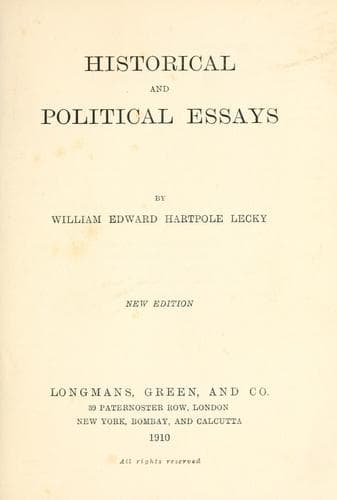
Historical and Political EssaysLecky, William Edward Hartpole
History
Historical and Political Essays
Lecky, William Edward Hartpole
History; Political science
If the matter could have been decided by pure reasoning, this report
might have been generally accepted as decisive. But many of the
supporters of the Government had at the election made speeches in
favour of old-age pensions. One of its most powerful members had
thrown his weight into the scale. The idea had taken hold of great
sections of the working classes. The trade-unions, that see in
increasing old-age poverty the chief drawback to their policy of
enforcing in each trade a uniform and minimum wage, were naturally
delighted that the State should undertake, out of public funds, to
remove their difficulty. A number of Bills dealing with the question
had been introduced into the House of Commons by private members; and
the reluctance of the Government to take it up had become a favourite
form of party attack. The Government acted as perhaps most
Governments, under the circumstances, would have done. While refusing
to give any pledge, and repudiating any sympathy with the idea of
universal pensions, and insisting that an encouragement of thrift
should be an essential condition of any old-age pension scheme, they
refused to admit that a false departure had been made; and they
appointed a new Committee--of which the writer of these lines was a
member--to report upon the best means of improving the condition of
the aged deserving poor, and upon the feasibility of dealing with
their case by old-age pensions.
Mr. Chaplin, the President of the Local Government Board, an
experienced and very popular member of the Cabinet, presided over the
Committee; and the fact that he drew up the report of the majority
gave that report its chief political importance. The Committee
consisted largely of members who had already committed themselves
deeply in favour of old-age pensions; and it will hardly be disputed
in England that it carried with it much less financial and political
weight than its predecessors; and that the majority report--which was
carried by 9 to 4--is more remarkable for the boldness of its
recommendations than for the cogency of its reasoning. It completely,
and almost contemptuously, discarded the conclusions of the majority
of the Aberdare Commission, and the unanimous opinion of the
Rothschild Committee; and it recommended that old-age pensions,
derived in part from Imperial and in part from local sources, and
varying from 5_s._ to 7_s._ a week, should be granted to all the
deserving poor who had attained the age of sixty-five and whose
incomes did not exceed 10_s._ a week. It proposed that these pensions
should be granted by committees established in every poor-law union
and elected by the poor-law guardians; that they should be revised
every three years; and that they should be distributed through the
agency of the post-office.
Public-domain text, read in full here on John Shaqi.
Reviews
Reviews
No reviews yet
Be the first to share your thoughts on this work.
Elsewhere in the archive
Join the Discussion
Join the discussion
Sign in to leave a comment or review.
Sign InorCreate an account