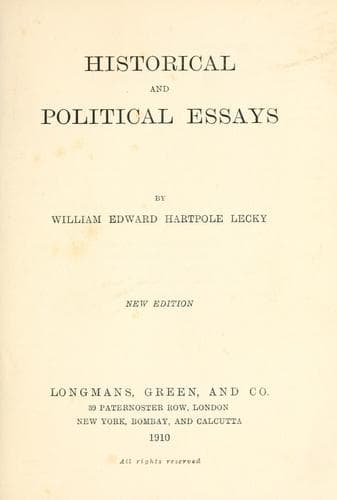
Historical and Political EssaysLecky, William Edward Hartpole
History
Historical and Political Essays
Lecky, William Edward Hartpole
History; Political science
On the great difficulties that seemed so formidable to its
predecessors it touched very lightly. How many of the poor were likely
under the proposed system to become pensioners, and what burden of
taxation was likely to be thrown on the State, were questions that
were put aside as irrelevant to the inquiry. To meet the enormous
difficulty of deciding upon the real merits, and of investigating the
real circumstances, of the great masses of independent and industrious
labourers who live in the manufacturing towns, or are constantly
moving from one great centre of population to another, and circulating
in quest of work through the whole extent of the Empire, it was
suggested that the relief be confined to those who were resident in a
single locality; and it was pointed out that a number of charities,
endowed out of old legacies or donations, and applying to particular
classes or districts, had come to be administered by the Charity
Commissioners, and that in this restricted field they had been able to
convert a large part of the income at their disposal from doles into
permanent pensions.
The thrift test and the character test, which previous inquirers had
found it almost impossible to establish on a satisfactory basis, were
defined on the loosest lines. The pensioner must not, during the
preceding twenty years, have been sentenced to penal servitude or
imprisonment without the option of a fine; he must not, during the
same period of time, have been in receipt of poor-law relief 'other
than medical relief or unless under circumstances of a wholly
exceptional character'; and he must have 'endeavoured to the best of
his ability, by his industry and by the exercise of reasonable
providence, to make provision for himself and those immediately
dependent on him.'
The extreme vagueness and the extreme elasticity of such provisions
are sufficiently manifest; and it is difficult to see how they can
give any real assistance in practical legislation; while they leave
the door open to the largest and most lavish expenditure. I have
endeavoured in a minority report to deal with these questions at
somewhat greater length than my present space will admit; but a few
pages may suffice to give an outline of the case of those who believe
the new policy to be both mistaken and dangerous.
Public-domain text, read in full here on John Shaqi.
Reviews
Reviews
No reviews yet
Be the first to share your thoughts on this work.
Elsewhere in the archive
Join the Discussion
Join the discussion
Sign in to leave a comment or review.
Sign InorCreate an account