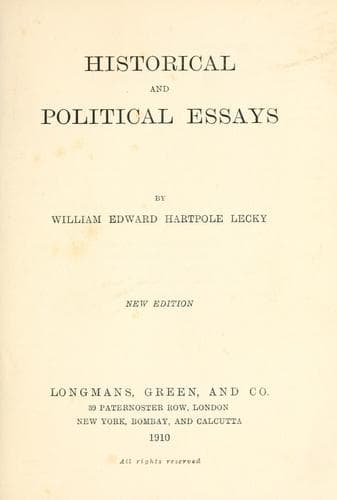
Historical and Political EssaysLecky, William Edward Hartpole
History
Historical and Political Essays
Lecky, William Edward Hartpole
History; Political science
Nothing is more certain or more cheering in the condition of modern
England than the extraordinary diminution that has taken place, during
the present generation, in pauperism. It began with the reform of the
poor law in 1834; and although it has been found possible to relax
greatly the stringency of the poor-law regulations that were then
made, it has steadily continued. Much of this is due to the increase
in the rate of wages which has taken place in most departments of
English industry, and which has been accompanied by a great decrease
in the cost of most of the chief necessaries of life, as well as by a
considerable reduction in the hours of work. Sir Robert Giffen, in the
very remarkable paper which he published, in 1883, on the condition of
the working classes in England during the preceding fifty years, has
shown that in every class of work in which it is possible to make a
comparison the wages of the labourer have in these fifty years risen
at least 20 per cent., and in most cases between 50 and 100 per cent.;
and he has clearly demonstrated that no other section of the community
has obtained so large a proportion of the increase of the national
wealth, and improved in so great a degree in material prosperity.
But the mere increase of wages is but one element of this improvement.
The very mainspring of the prosperity of the great masses of the
British working classes is to be found in their increased sobriety,
and in the habits of thrift and providence that have followed the
spread of education. The statistics of the Friendly Societies, the
Industrial and Provident Societies, the Building Societies, the
savings-banks, and of countless other institutions, created by
voluntary working-class effort for the purpose of insuring against
sickness or death, and providing working-class investments, attest in
the clearest manner the rapid growth of provident and thrifty habits
among the wage-earning classes. In no other respect is the improvement
of the nation so marked and so indisputable and no element in the
national character is more important to its prosperity and to its
enduring greatness. In the evidence that was brought before our
Committee, it was shown that since 1849 the pauperism of Great Britain
had been reduced from 62.7 per 1,000 to 26.2 per 1,000, if lunatics
and vagrants are included, to 22.8 per 1,000, if lunatics and vagrants
are excluded.
The first, and most vital, condition of any sound legislation for the
relief of poverty is that it should not impair these industrial
qualities, or weaken these vast voluntary organisations of self-help
which are their result. Can it be said that the old-age pension policy
is compatible with this condition?
Public-domain text, read in full here on John Shaqi.
Reviews
Reviews
No reviews yet
Be the first to share your thoughts on this work.
Elsewhere in the archive
Join the Discussion
Join the discussion
Sign in to leave a comment or review.
Sign InorCreate an account