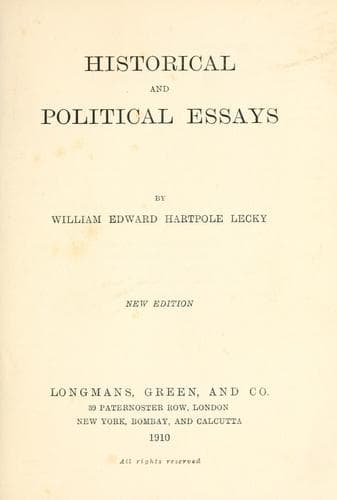
Historical and Political EssaysLecky, William Edward Hartpole
History
Historical and Political Essays
Lecky, William Edward Hartpole
History; Political science
I have been asked on the present occasion to deliver a short address
which might serve as an introduction to the course of lectures and
conferences on the history and resources of the different portions of
the Empire which are to take place in the Imperial Institute. In
attempting to discharge this task my first reflection is one which the
very existence of the Institute can hardly fail to suggest to anyone
with any knowledge of recent history. It is the great revolution of
opinion which has taken place in England within the last few years
about the real value to her both of her colonies and of her Indian
Empire. Not many years ago it was a popular doctrine among a large and
important class of politicians that these vast dominions were not
merely useless but detrimental to the mother-country, and that it
should be the end of a wise policy to prepare and facilitate their
disruption. Bentham, in a pamphlet called 'Emancipate your Colonies,'
advocated a speedy and complete separation. James Mill, who held a
high place among these politicians, wrote an article on Colonies for
the 'Encyclopædia Britannica' which clearly expresses their view.
Colonies, he contended, are very little calculated to yield any
advantage whatever to the countries that hold them, and their chief
influence is to produce and prolong bad government. Why, then, he
asks, do European nations maintain them? The answer is very
characteristic, both of the man and of his school. Something, he
charitably admits, is due to mere ignorance, to mistaken views of
utility; but the main cause is of another kind. He quotes the saying
of Sancho Panza, who desired to possess an island in order that he
might sell its inhabitants as slaves, and put the money in his pocket;
and he maintains that the chief cause of our Colonial Empire is the
selfish interest of the governing few who valued colonies because they
gave them places and enabled them to multiply wars. In more moderate
and decorous language, Goldwin Smith wrote a book, the object of which
was to show how desirable it was that this Empire should be gradually
but steadily reduced to the sweet simplicity of two islands. Similar
views prevailed very generally in the Manchester school. Cobden
frequently expressed them. The question of the colonies, he
maintained, was mainly a question of pounds, shillings, and pence; he
proved, as he imagined, by many figures that they were a very bad
bargain; and he expressed his confident hope that one of the results
of free trade would be 'gradually and imperceptibly to loosen the
bands which unite our colonies to us.' About our Indian Empire he
entertained much stronger opinions. He described it as a calamity and
a curse to the people of England. He looked on it, in his own words,
'with an eye of despair,' and declared that it was destroying and
demoralising the national character. It was the belief of his school
of politicians that all the nations of the world would speedily follow
Public-domain text, read in full here on John Shaqi.
Reviews
Reviews
No reviews yet
Be the first to share your thoughts on this work.
Join the Discussion
Join the discussion
Sign in to leave a comment or review.
Sign InorCreate an account