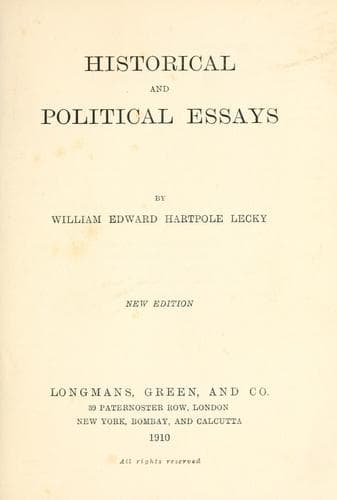
Historical and Political EssaysLecky, William Edward Hartpole
History
Historical and Political Essays
Lecky, William Edward Hartpole
History; Political science
I do not believe that opinions of this kind, though they were held by
a large and powerful section of English politicians, ever penetrated
very deeply into the English nation. One of the causes of Mr. Cobden's
'despair' was his conviction that the English people would never be
persuaded to surrender India except at the close of a disastrous and
exhausting war, and in his day the policy of national surrender was
certainly not that of the statesmen who led either party in
Parliament. No one would attribute it to Mr. Disraeli, in whose long
political life the note of Imperialism was perhaps that which sounded
with the clearest ring, and it was quite as repugnant to Lord
Palmerston and Lord John Russell. In an admirable speech which was
delivered in the beginning of 1850, Lord John Russell disclaimed all
sympathy with it, and I can well remember the indignation with which
in his latter days he was accustomed to speak of the views on the
subject which were then frequently expressed. 'When I was young,' he
once said to me, 'it was thought the mark of a wise statesman that he
had turned a small kingdom into a great empire. In my old age it
appears to be thought the object of a statesman to turn a great
empire into a small kingdom.'
I do not think that anyone who has watched the current of English
opinion will doubt that the views of the Manchester school on this
subject have within the last few years steadily lost ground, and that
a far warmer and, in my opinion, nobler and more healthy feeling
towards India and the colonies has grown up. The change may be
attributed to many causes. In the first place, what Carlyle called
'The Calico Millennium' has not arrived. The nations have not adopted
free trade, but nearly all of them, including unfortunately many of
our own colonies, have raised tariff walls against our trade. The
Reign of Peace has not come. National antipathies and jealousies play
about as great a part in human affairs as they ever did, and there are
certainly not less than three and a half millions, there are probably
nearly four millions, of men under arms in what are called the peace
establishments of Europe. It is beginning to be clearly seen that,
with our vast, redundant, ever-growing population, with our enormous
manufactures, and our utterly insufficient supply of home-grown food,
it is a matter of life and death to the nation, and especially to its
working classes, that there should be secure and extending fields open
to our goods, and in the present condition of the world we must mainly
look for these fields within our own Empire. The gigantic dimensions
that Indian trade has assumed within the last few years, and the
extraordinary commercial development of some other parts of our
Empire, have pointed the moral, and it has been made still more
apparent by the eagerness with which other Powers, and especially
Germany, have flung themselves into the path of colonisation. In an
Public-domain text, read in full here on John Shaqi.
Reviews
Reviews
No reviews yet
Be the first to share your thoughts on this work.
Join the Discussion
Join the discussion
Sign in to leave a comment or review.
Sign InorCreate an account